Who Is Liable for a Car Accident in the Rain?
Related Posts
Contact Us
Let Our Team Fight For You

In most rain crashes, the driver who failed to slow down or take extra care for wet conditions is the one who is liable. Rain alone is not an excuse under Pennsylvania law, since drivers are expected to adjust their speed, following distance, and attention to the weather. Sometimes more than one person shares the blame, including a vehicle owner, an employer, or a government agency that failed to fix a road hazard.
Insurance companies often blame the weather and try to avoid paying. At Metzger Wickersham, our firm began in 1888 with attorney Frank B. Wickersham, and today we represent people hurt in crashes, at work, and by disabling conditions.
Why Rain Does Not Excuse a Driver’s Mistakes
Pennsylvania’s Vehicle Code requires every driver to use a speed that is reasonable and prudent for the conditions. That includes a speed slow enough to stop within the distance the driver can see ahead. The safe speed rule can apply even when a driver is under the posted speed limit.
A posted limit of 55 miles per hour does not make 55 safe during a downpour. Wet pavement makes it harder to stop and steer. A driver who ignores that may be found at fault even if no ticket is written.
Rain also cuts visibility, so drivers need more time to react. Spray from trucks and fogged windows can make it harder to see the road ahead. Careful drivers slow down early and leave extra room.
Insurance companies and courts often look at these common mistakes in rain crashes:
- Driving too fast for the road conditions
- Following the car ahead too closely
- Braking late or suddenly
- Driving on worn tires, weak brakes, or old wiper blades
- Driving through standing water
- Looking at a phone or other distractions
Drivers also need to see and be seen. Pennsylvania requires headlights whenever windshield wipers are in use because of rain or mist, and a driver who skips this step may share the blame.
Common Types of Rain Crashes and Who May Be at Fault
The facts of the crash often point to who is responsible, and each type of crash raises different questions about fault.
Rear-End Collisions
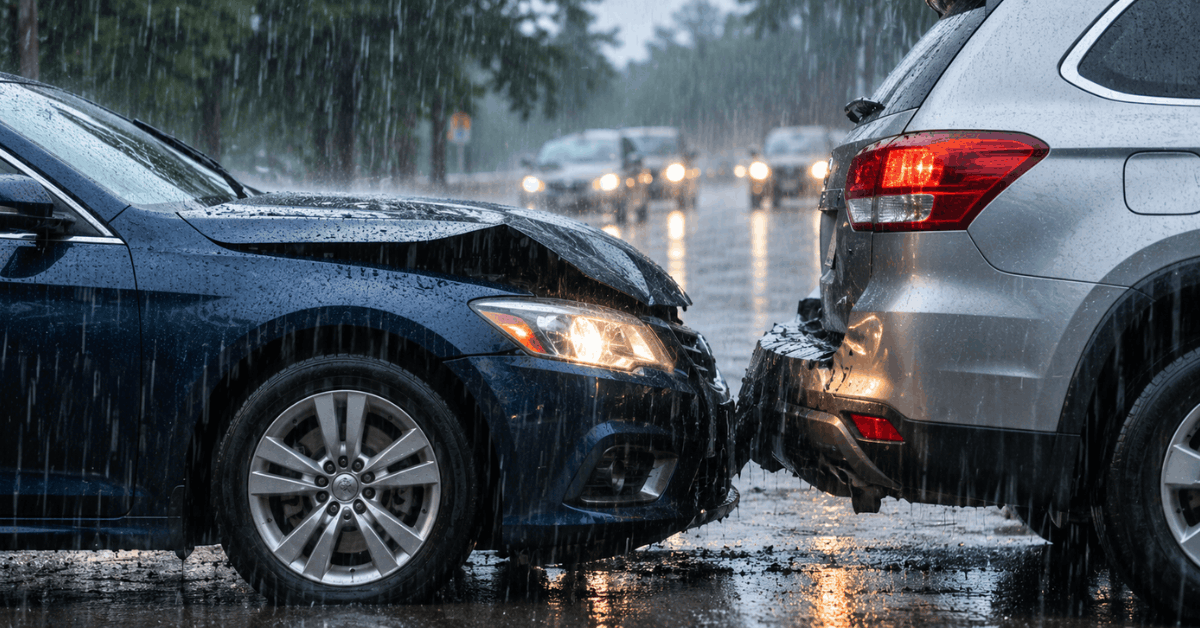
Rain makes it harder to stop, and the rear driver is often found at fault for following too closely or driving too fast. A sudden stop by the front driver can still matter, such as a stop made for no reason or one made with broken brake lights. Each driver’s share of fault depends on the evidence.
Hydroplaning Crashes
Hydroplaning happens when a layer of water lifts the tires off the road, and the driver loses steering and braking control. Insurers may call these crashes unavoidable. A driver who was going too fast for the conditions, or who had worn tires, may still be responsible.
Intersection Crashes
Wet roads and poor visibility make signals and stop signs harder to see. A driver who runs a red light or fails to stop is generally at fault, even if heavy rain made the signal hard to spot. Drivers are expected to slow down when they cannot see well.
Multi-Vehicle Pileups
When several vehicles crash in a chain, fault can be spread across many drivers. The first impact may not be the only cause. Video, vehicle data, and witness statements are often needed to sort out who hit whom and why.
Crashes Involving Trucks and Motorcycles
Large trucks need much more distance to stop on wet roads, so truck drivers and trucking companies may share responsibility if they ignored the conditions. Questions about speed, braking, and company safety rules often come up in our truck accident cases. Motorcyclists are harder to see in heavy rain, and a driver who fails to watch for them may be responsible for the crash.
Can Anyone Other Than a Driver Be Responsible?
Depending on the facts, other people or companies may share responsibility for a rain crash. These are some examples.
- The vehicle owner: An owner who lends a car to someone they know is unsafe, or who ignores needed repairs, may share the blame.
- An employer: If the driver was working at the time, the employer may be responsible for the driver’s actions.
- A government agency: Poor drainage, deep potholes, or missing signs can contribute to a crash, but claims against government have special rules.
- A property owner: Water that pools in a parking lot or driveway because of poor drainage may lead to a premises liability claim.
- A repair shop or manufacturer: Faulty tires, brakes, or wipers may point to a repair mistake or a product defect.
Claims against government agencies can be the hardest to bring. Pennsylvania generally requires written notice to the government unit within six months of the injury, and the law limits when these claims are allowed. If you think a road hazard played a part, ask about it right away.
How Pennsylvania’s Fault Rules Work
Pennsylvania uses a rule called comparative negligence. Under it, you can generally still recover money if your share of the blame is not greater than the other driver’s share. Your recovery is then reduced by your percentage of fault.
For example, say a jury decides your losses total $50,000 and finds you 30 percent at fault. Your recovery would generally be reduced to $35,000.
Insurers may try to raise your share of fault by claiming you were speeding or braked too hard. A police report or a traffic ticket does not always settle who was at fault in a civil claim. The evidence about speed, distance, and visibility matters.
Why Fault Can Be Hard to Prove in the Rain
After a rain crash, drivers often tell very different stories. Rain can wash away skid marks and hide brake lights, and many drivers say they simply could not see. Without good evidence, a claim can turn into one driver’s word against another’s.
That is why early photos, video, and witness names matter so much. They can show how fast a vehicle was going, how much room the drivers had, and what the road looked like at the time.
What Insurers May Say About the Weather
Insurers sometimes argue that the rain caused the crash and that no one is to blame. You may also hear the term “sudden emergency,” which refers to a driver who faces a danger they did not create. Courts generally look at what the driver did before the crash.
If speed, tailgating, or distraction helped create the danger, a sudden emergency argument may not hold up. A driver can have a fair claim of surprise and still be partly at fault. These arguments are common, and they are worth discussing with a lawyer before you accept blame or a low offer.
Medical Bills and Insurance After a Rain Crash
Pennsylvania uses a no-fault system for the first round of medical bills. Your own auto policy, a policy in your household, or the policy on the vehicle you were riding in generally pays those bills no matter who caused the crash. Pennsylvania requires most policies to include at least $5,000 in medical benefits, and many policies include more.
If another driver was at fault, you may also have a claim against that driver’s liability insurance. That claim can include lost income, future treatment, and pain and suffering. Pennsylvania only requires drivers to have $15,000 in injury coverage per person, so your own underinsured motorist coverage may matter in a serious crash.
Your tort choice on your own policy can also matter. If you chose limited tort, you may be able to recover for pain and suffering only if your injury meets the law’s definition of a serious injury. That definition includes serious impairment of a body function or permanent serious disfigurement.
Evidence That Matters After a Rain Crash
Rain can wash away evidence fast, so these items are worth saving or photographing right away.
- Photos of the road: Standing water, potholes, faded lane lines, and skid marks can all help show what happened.
- Weather records: Rainfall and visibility data may show how bad conditions were at the time.
- Video: Dashcams, security cameras, and traffic cameras may show speed and braking, but footage is often erased quickly.
- Vehicle data: Many newer vehicles store speed and braking data that can be downloaded.
- Maintenance records: Tire, brake, and wiper records can matter if a defect or neglected repair is suspected.
- Witness information: People who saw the crash can be hard to find later.
Steps to Take After a Crash in the Rain
A crash on a wet road can be frightening, and the weather can make the scene more dangerous. These steps can help protect your safety and your claim.
- Get to safety: If you can, move out of traffic and turn on your hazard lights.
- Call 911: Ask police and medical help to come, and make sure a report is written.
- Exchange information: Get names, license plate numbers, and insurance details from every driver involved.
- Take photos: Photograph the vehicles, the road, the weather, and any injuries before conditions change.
- Get medical care: See a doctor soon, even if you feel fine, since some injuries show up later.
- Report the crash: Tell your insurer promptly, since policies set their own notice rules.
- Watch what you say: Do not guess about speed or admit fault, and think twice before giving a recorded statement to another driver’s insurer.
Deadlines to Keep in Mind
Pennsylvania generally gives you two years from the date of the crash to file a lawsuit for injuries caused by someone else’s negligence. Some situations can change that deadline, such as when the injured person is a child.
Claims against a government unit can have a much shorter notice deadline, as short as six months. The notice is usually a written statement with details such as the date and time, the place, and the names and addresses of the people hurt and of any doctor who treated them. It must go to the right office.
Insurance policies may also set their own notice rules. Waiting can hurt your claim, even when the other driver’s fault seems clear.
Common Questions About Liability in Rain Crashes
Is the Driver Who Hits Your Car From Behind Always at Fault?
Not always, although the rear driver often shares much of the blame. A front driver who stopped suddenly for no reason, or whose brake lights did not work, may share fault. Photos, video, and witness accounts can help sort this out.
What If the Other Driver Left the Scene?
You may be left without a driver to pursue after a hit-and-run crash in the rain. Your own auto policy may still pay your medical bills, and your uninsured motorist coverage, if you have it, may apply to other losses. That coverage generally requires a police report and notice to your insurer within 30 days, so call the police right away.
Can You Still Recover If You Were Partly at Fault?
Often, yes. Under Pennsylvania’s comparative negligence rule, you can generally still recover if your share of the blame is not greater than the other driver’s share. Your payment is reduced by your percentage of fault.
Does a Traffic Ticket Prove Who Is Liable?
A ticket shows that an officer saw a possible violation, but it does not always decide fault in an injury claim. Insurance companies and courts weigh all of the evidence. A driver who was not ticketed can still be found responsible.
How Our Lawyers Can Help After a Rain Crash
Fault in a rain crash is rarely simple, and the other side often points to the weather. Our car accident lawyers look closely at speed, following distance, lighting, vehicle condition, and road hazards. We also look at whether more than one party shares responsibility.
Our personal injury lawyers can help with several parts of your claim:
- Gathering police reports, photos, video, and vehicle data
- Identifying every person or company that may share blame
- Handling calls and paperwork with insurance companies
- Working with your doctors to document your injuries
- Estimating the full value of your losses, including future care
- Filing a lawsuit before the deadline if one is needed
Some rain crashes cause catastrophic injuries that change how a person works and lives. In those cases, a claim may need to account for years of treatment and lost income.
Every case is different, and we cannot promise a particular result. We can explain your options and the steps that may apply to your situation.
Get Answers After Your Rain Crash
Your first consultation with Metzger Wickersham is free. Call (717) 910-6230 or send us a message online to tell us what happened. You pay no attorney fees unless we win your case.
