When Workplace Accidents Happen: Understanding Your Need for Legal Support
Workers’ comp lawyers assist injured employees with complex compensation claims and fight for fair settlements after workplace accidents. Here’s what you need to know:
Key Services of Workers’ Comp Lawyers:
Workers’ Compensation Claims – Handle no-fault insurance claims for medical bills and lost wages
Third-Party Lawsuits – Pursue claims against equipment manufacturers, contractors, or property owners
Claim Appeals – Challenge denied or underpaid workers’ compensation benefits
Settlement Negotiation – Fight for maximum compensation from insurance companies
Legal Guidance – Steer reporting deadlines and protect your rights
Millions of workplace injuries occur annually in the U.S. When you’re hurt at work, you face medical bills, lost income, and an uncertain future. The legal system can be overwhelming, especially while dealing with physical and financial stress. Research indicates that workers who hire attorneys often receive higher settlements than those who handle claims alone.
Most workplace injuries are covered by workers’ compensation, a no-fault system for medical expenses and partial wage replacement. However, you might also have a claim against third parties, like equipment manufacturers or negligent contractors, for additional damages such as pain and suffering. Workers’ comp is usually the exclusive remedy against your employer, but exceptions exist for intentional harm or if the employer lacks required insurance.
In Pennsylvania, the three-year statute of limitations for personal injury claims makes acting quickly essential to protect your rights and preserve evidence.
Understanding Your Legal Options: Workers’ Comp vs. A Lawsuit
After a work injury, you may feel confused about your legal options. Your path will generally lead to either the workers’ compensation system or, in some cases, a personal injury lawsuit. Understanding the difference is crucial for your recovery.
Workers’ compensation is a “no-fault” system designed to provide quick assistance to injured workers without needing to prove employer negligence. If you were hurt on the job, you’re typically covered for medical care and lost wages. However, this system is usually your “exclusive remedy,” meaning you cannot sue your employer for damages like pain and suffering.
In rare cases, you can sue your employer directly. Additionally, if another party contributed to your injury, a “third-party liability” claim may be possible, potentially leading to more comprehensive compensation.
Our website offers a detailed guide to workers’ compensation benefits.
Can You Sue Your Employer Directly for an Injury at Work?
Generally, you cannot sue your employer for a work injury. This is the trade-off of the workers’ compensation system, which provides benefits without you needing to prove fault. In return, employers are protected from most direct lawsuits.
However, there are important exceptions:
Intentional Injury: You may sue if your employer intentionally caused your injury. This requires proving malicious intent, which is a high standard.
Gross Negligence: In some states, including Pennsylvania, you might have grounds for a lawsuit if your employer’s reckless carelessness led to your injury.
No Workers’ Comp Insurance: If your employer illegally failed to carry required workers’ compensation insurance, you may be able to sue them directly.
Dual Capacity Doctrine: In rare cases, an employer may be sued if they acted in another capacity that caused the injury (e.g., as the manufacturer of faulty equipment).
Proving these exceptions is challenging due to strict legal standards. The guidance of a workers’ comp lawyer is valuable in determining if your case fits an exception and navigating the legal process.
What is Workers’ Compensation?
Workers’ compensation is a state-run insurance program providing a safety net for employees injured or sickened due to their job. It offers financial support and medical care without a lengthy lawsuit.
Key benefits include:
Medical Expense Coverage: Covers all necessary medical care, including doctor visits, surgery, prescriptions, and physical therapy.
Lost Wage Replacement: Replaces a portion of your lost income if you cannot work. In Pennsylvania, this is typically about two-thirds of your average weekly wage, up to a state-mandated limit.
Specific Loss Payments: Provides additional payments for the permanent loss of a body part or its use, or for severe disfigurement.
Death Benefits: Offers surviving family members partial wage replacement and burial cost assistance if a work injury is fatal.
Vocational Rehabilitation: May provide services to help you find new work if you cannot return to your old job.
Filing a claim involves notifying your employer and submitting state paperwork within specific deadlines. You can learn more about the workers’ compensation system on our website.
When Can You Sue a Third Party?
While you generally cannot sue your employer, you may be able to sue other individuals or companies whose negligence contributed to your accident. A third-party lawsuit can allow you to seek damages not covered by workers’ comp, such as pain and suffering.
Common examples of third parties include:
Equipment Manufacturers: If a defective machine, tool, or piece of safety equipment caused your injury, the manufacturer could be held responsible.
Property Owners: If you were injured on property owned by someone other than your employer due to unsafe conditions, you may have a claim against the owner.
Subcontractors: On job sites with multiple companies, a careless worker from another company who causes your injury could be held liable.
Other Drivers: If you were hurt in a work-related car accident caused by another driver, you can pursue a claim against that driver.
A workers’ comp lawyer can investigate your accident to identify all potentially responsible parties. Our website also provides more information on complex cases like construction site accidents.
What Types of Compensation Can You Receive?
After a work injury, compensation is about covering current costs and ensuring future financial stability. The type of compensation available depends on whether your claim is a workers’ compensation case or a third-party lawsuit.
Compensation generally covers medical bills and lost income. In third-party lawsuits, you may also claim for pain and suffering, which is not typically available through workers’ comp. Damages are broken down into two main types: economic damages (measurable financial losses) and non-economic damages (less tangible losses). These categories help account for the full impact of your injury, including future earnings loss or a permanent impairment rating.
Economic Damages
Economic damages are the measurable financial losses resulting from your injury. The goal is to restore you to the financial position you were in before the accident.
These damages include:
Medical treatments: All healthcare costs, from emergency room visits to surgeries and follow-up appointments.
Prescription costs: The cost of necessary medications for your injury.
Physical therapy: Costs for physical, occupational, or other rehabilitation services.
Lost wages: Compensation for income you’ve already lost due to being unable to work.
Future medical expenses: Estimated costs for ongoing medical care, future surgeries, or long-term medication.
Loss of earning capacity: Compensation for a long-term reduction in your ability to earn money.
Out-of-pocket expenses: Other costs related to your injury, such as travel for medical care or home modifications.
Keeping detailed records of all bills, receipts, and lost income is crucial to substantiating your claim.
Non-Economic Damages
Non-economic damages compensate for non-financial losses from your injury. These damages are personal, subjective, and generally only available in third-party lawsuits, not workers’ compensation claims.
These damages cover:
Pain and suffering: Compensation for the physical pain and emotional discomfort caused by your injury.
Emotional distress: Addresses the psychological impact, such as anxiety, depression, or PTSD.
Loss of enjoyment of life: For the inability to participate in hobbies, sports, or other activities you once enjoyed.
Disfigurement: Compensation for permanent scars, loss of a limb, or other changes to your appearance.
Valuing non-economic damages requires a thorough understanding of the legal system and the ability to demonstrate how the injury has impacted your life. The experience of a workers’ comp lawyer is invaluable in this area.
Why You Need to Hire A Workers’ Comp Lawyer
Managing a workplace injury claim while recovering can be overwhelming. The legal and insurance systems are complex, and mistakes can jeopardize your claim. An experienced workers’ comp lawyer can provide essential guidance.
Here’s how legal representation can help:
Navigating Complex Laws: Workers’ compensation and personal injury rules are intricate. A workers’ comp lawyer ensures your case is handled correctly according to state laws.
Negotiating with Insurance Companies: Insurers aim to minimize payouts. A workers’ comp lawyer knows their tactics and can negotiate firmly on your behalf to counter lowball offers.
Maximizing Settlements: Studies show that injured workers with legal representation often receive higher settlements. A workers’ comp lawyer fights for the full compensation you deserve.
Avoiding Costly Mistakes: Errors like missing deadlines or saying the wrong thing to an adjuster can harm your claim. A workers’ comp lawyer guides you to avoid these pitfalls.
Representing You in Hearings: If your claim is disputed, you may need to appear before a judge. A workers’ comp lawyer can prepare your case, present evidence, and advocate for you effectively.
Our goal is to handle the legal burden so you can focus on your recovery.
What to Look for in a workers’ comp lawyer
Choosing the right legal representation is a critical decision. When looking for a workers’ comp lawyer , consider these qualities:
Experience with Similar Cases: Seek a firm with a proven history of handling workplace injury claims like yours. Our firm has over 135 years of collective experience guiding clients through personal injury cases.
Reputation and Reviews: Positive client testimonials and strong reviews indicate a history of successful outcomes and client satisfaction.
Local Knowledge: A firm with local knowledge of Pennsylvania’s laws, courts, and procedures provides a distinct advantage.
Clear Communication: Your legal team should explain complex concepts clearly, provide regular updates, and be accessible for questions.
Track Record of Success: A strong history of resolving cases, either through negotiation or in court, demonstrates a firm’s capabilities.
Resources to Handle the Case: Complex cases require significant resources for investigations, expert witnesses, and potential trials. Ensure the firm is well-equipped to build a strong case for you.
We are committed to providing each client with the dedicated attention and resources their case requires.
How are workers’ comp lawyer Paid?
Many injured workers worry about the cost of hiring a lawyer. Most workers’ comp lawyers work on a contingency fee basis, also known as “no win, no fee,” making legal help accessible regardless of your financial situation.
Here’s how it works:
No Upfront Costs: You pay nothing to hire us. We cover the initial costs of your claim, like filing fees and investigation expenses.
Percentage of Settlement: Our fee is a pre-agreed percentage of the compensation we recover for you.
No Win, No Fee: If we do not win your case, you owe us no legal fees. This model minimizes your financial risk.
We also offer a free initial consultation to discuss your case and legal options without any financial commitment. This payment structure aligns our goals with yours—we only get paid if you do—allowing you to focus on recovery while we handle your claim.
Critical Steps to Take After a Workplace Injury
The actions you take immediately after a work injury are critical. Following the right steps can protect your health and your ability to receive compensation.
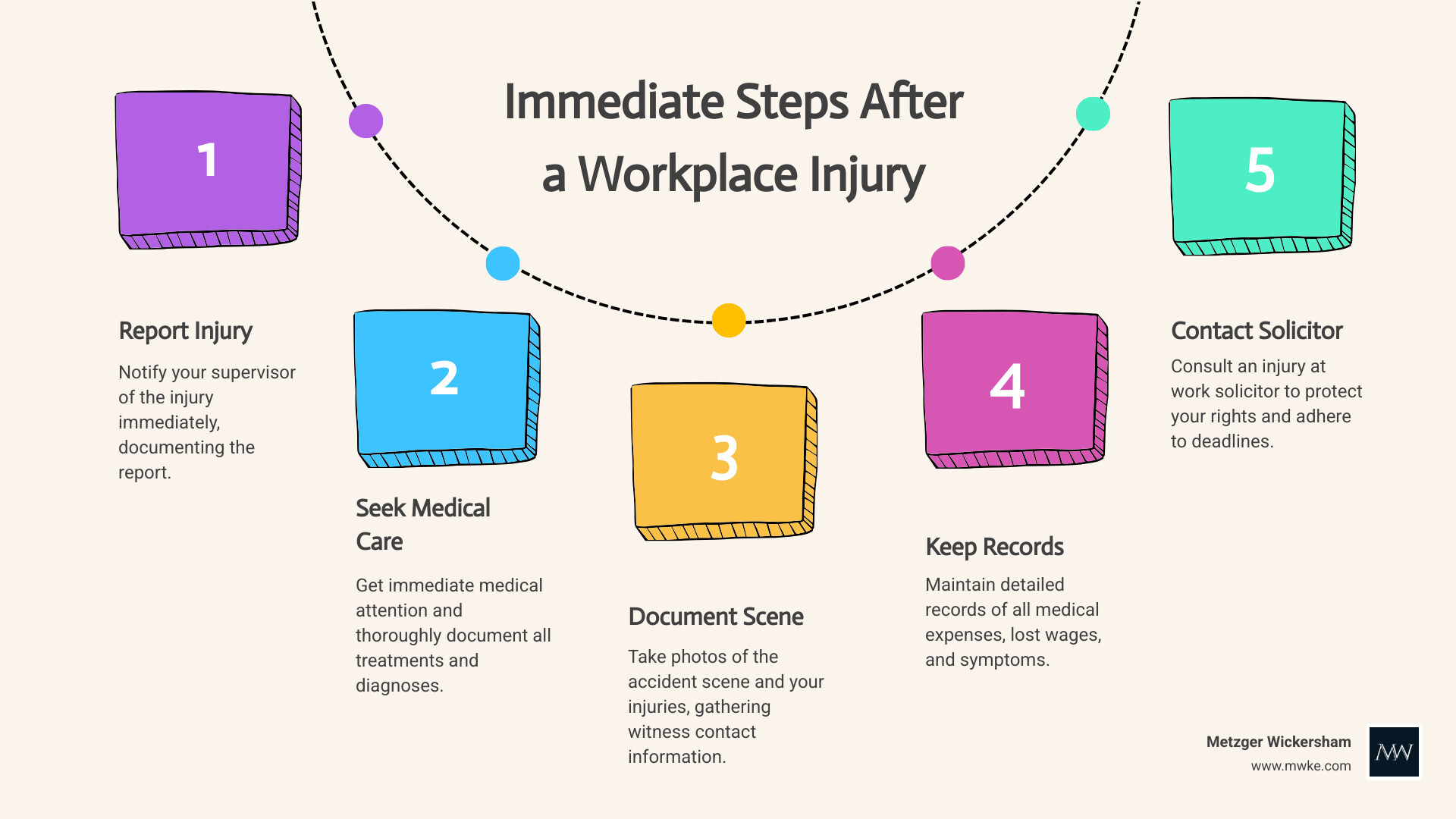
Key actions include reporting the incident, seeking medical attention, documenting the scene, gathering evidence, and adhering to strict deadlines.
Immediately After the Accident
Your safety is the top priority. Once you are safe, take these immediate steps:
Report the injury to your supervisor immediately. This is a crucial step. In Pennsylvania, you must notify your employer within 120 days for workers’ compensation eligibility, but it is best to do so right away. Ensure an official report is filed.
Get immediate medical care. Seek a medical evaluation even if the injury seems minor. This creates an official record linking your injury to the workplace. Inform the medical provider that the injury is work-related.
Take photos of the scene and your injuries. Document the accident location, any faulty equipment, and the hazard that caused the injury. Photograph your injuries as well.
Get contact information from witnesses. Their accounts can be valuable evidence later.
Do not sign any insurance documents or settlement offers without having them reviewed by a workers’ comp lawyer . Insurers may try to settle for a low amount before the full extent of your injuries is known.
Filing Your Claim and Protecting Your Rights
After the initial steps, focus on formally filing your claim and protecting your rights:
File an official claim. Your employer should provide the necessary workers’ compensation forms. Ensure they are filled out correctly and completely. Contact a workers’ comp lawyer if you encounter any issues.
Follow all medical advice. Adhere to your doctor’s treatment plan, attend all appointments, and take prescribed medications. This demonstrates the seriousness of your injury.
Keep detailed records of expenses and symptoms. Maintain a log of all medical appointments, travel costs, lost wages, and other injury-related expenses. Also, document your daily pain levels and how the injury impacts your life.
Be aware of the statute of limitations. In Pennsylvania, you must notify your employer within 120 days for workers’ comp. You generally have three years from the injury date to file a formal claim petition. The statute of limitations for third-party lawsuits is also typically three years. Missing these deadlines can prevent you from receiving compensation.
Navigating these steps can be challenging, and a workplace injury lawyer can provide the guidance you need.
Frequently Asked Questions about Workplace Injury Claims
It’s normal to have many questions after a workplace injury. The legal system can be confusing, but you are not alone. We’ve answered some of the most common questions to help you feel more in control.
How long do I have to file a workplace injury claim in Pennsylvania?
In Pennsylvania, several key deadlines apply to workplace injury claims. Missing them can result in losing your right to compensation.
Notification to Employer: You must notify your employer of your injury within 120 days to be eligible for workers’ compensation. It is advisable to report any injury immediately, no matter how minor it seems.
Filing a Claim Petition: You generally have three years from the date of injury to file a formal workers’ compensation Claim Petition with the state.
Third-Party Lawsuits: The statute of limitations for filing a personal injury lawsuit against a third party is also typically three years from the accident date.
Acting quickly is essential to preserve evidence and protect your legal rights.
Can I be fired for filing a workers’ compensation claim?
No, your employer cannot legally fire, demote, or otherwise retaliate against you for filing a workers’ compensation claim. This is considered wrongful termination or illegal retaliation under worker protection laws.
However, this protection does not prevent your employer from terminating you for other legitimate reasons, such as poor performance that predates your injury or company-wide layoffs. The termination cannot be a direct result of you seeking benefits.
If you believe you are facing retaliation for filing a workers’ compensation claim, contact a workers’ comp lawyer immediately. We can review your situation, explain your rights, and help protect you from unlawful actions.
What if my workers’ compensation claim is denied?
A denied workers’ compensation claim can be disheartening, but it is not the end of the process. You have the right to appeal the decision.
Claims are often denied for reasons like missing paperwork, disputes over whether the injury is work-related, or insufficient evidence. If your claim is denied, the appeals process typically involves:
Filing an Appeal: You must submit a formal petition to the Pennsylvania Workers’ Compensation Board.
Hearings Before a Judge: Your case will be heard by a Workers’ Compensation Judge, where evidence is presented and testimony is given.
Further Appeals: Decisions can be appealed to higher boards and state courts if necessary.
The appeals process is complex. Having a workers’ comp lawyer on your side is crucial for gathering evidence, preparing for hearings, and building a strong legal argument to fight for your benefits.
Get the Guidance You Need for Your Work Injury Claim
Sustaining an injury at work is an overwhelming experience, involving physical pain, lost wages, and uncertainty. You do not have to steer the complex legal process alone.
A qualified workers’ comp lawyer can protect your rights, explain your options, and fight to secure the full compensation you deserve. They act as your guide, ensuring your case is handled properly and your voice is heard.
At Metzger Wickersham, we understand the challenges you face. With over 135 years of experience, our team is committed to helping injured workers seek justice and regain their footing. We stand by our clients every step of the way.
If you’ve been hurt on the job, taking the first step by reaching out can provide peace of mind. We offer a comprehensive case review to help you understand your legal options without pressure. To learn more, please see our Workers’ Compensation resources available online. We are ready to help.
 Skip to content

 Compensation generally covers medical bills and lost income. In third-party lawsuits, you may also claim for pain and suffering, which is not typically available through workers’ comp. Damages are broken down into two main types: economic damages (measurable financial losses) and non-economic damages (less tangible losses). These categories help account for the full impact of your injury, including future earnings loss or a permanent impairment rating.
 Here’s how legal representation can help:
 Key actions include reporting the incident, seeking medical attention, documenting the scene, gathering evidence, and adhering to strict deadlines.

