When Your Workers’ Compensation Claim Gets Rejected
A denied workers comp claim can be devastating, but a denial is not the final word.
If your workers’ comp claim was denied, you have options:
Don’t give up – You have the right to appeal.
Act fast –120 days to report your injury to your employer. 3 years to file a Claim Petition if no comp is paid.
You’re not alone – Almost 15% of initial claims are denied.
There’s hope – About half of workers who appeal win their cases and get benefits.
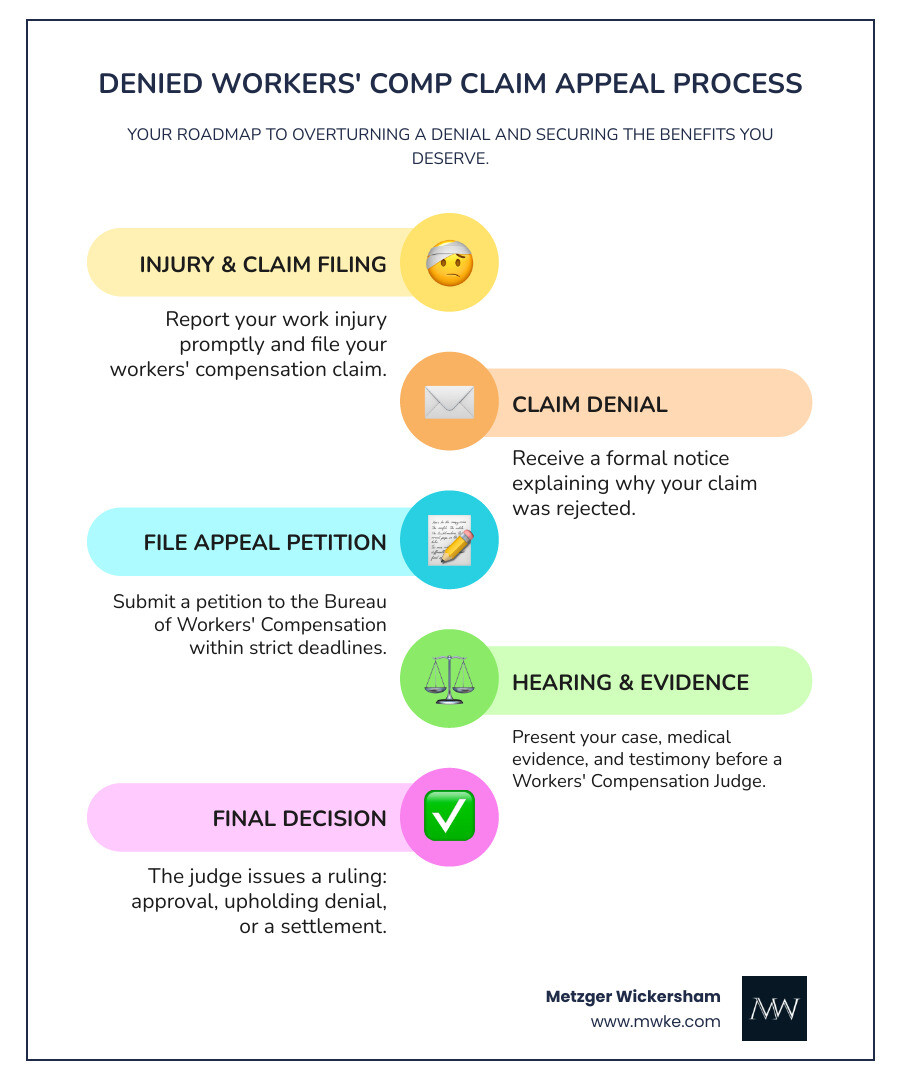
The process involves filing a petition with your state’s workers’ compensation board.
Many people give up after a denial, which is what insurance companies and employers often count on. The workers’ compensation system has built-in protections, and you must understand your rights and the appeal process to use them.
In Pennsylvania, the Bureau of Workers’ Compensation handles appeals. A Workers’ Compensation Judge will review your case. While the process can seem complex, thousands of workers successfully overturn denials every year by taking clear steps to fight back, regardless of the reason for the denial.
Must-know Denied workers comp claim terms:
Understanding why your workers’ compensation claim was denied is the first step toward a successful appeal. Insurers deny claims for various reasons, often hinging on details that can be challenged with the right evidence.
Injury Not Work-Related
A common reason for a denied workers comp claim is the assertion that your injury didn’t happen in the scope of your employment.
Commute Injuries: Injuries during your commute are generally not covered.
Lunch Break Incidents: An injury during an unpaid lunch break is typically not covered unless you were performing a work-related task.
Off-site Events: Coverage for injuries at company events can depend on whether attendance was mandatory or the event benefited the employer.
Horseplay: Injuries from roughhousing are often denied, but if the employer tolerated such behavior, you might have a case.
To counter this, you need evidence like witness statements and accident reports linking the injury to your job.
Issues with Medical Evidence and Treatment
Medical evidence is the backbone of your claim. A denial might be due to:
Lack of Medical Treatment: Delaying medical care can suggest the injury isn’t serious. Always seek prompt medical attention.
Unauthorized Medical Providers: In Pennsylvania, you may need to see an employer-approved doctor for the first 90 days. Using an unapproved doctor for non-emergency care can lead to a denial.
Insufficient Documentation: Your medical records must clearly link your injury to the work incident and describe your disability.
Disagreement with Doctor’s Opinion: The insurer might use an Independent Medical Examination (IME) from a company-chosen doctor to dispute your doctor’s findings.
Pre-Existing Conditions
Insurers often argue that a pre-existing condition is the sole cause of your disability. However, Pennsylvania law allows for benefits if a work injury aggravates or accelerates a pre-existing condition. To overcome this, you must establish “medical causation” through medical evidence, showing the work injury is the primary reason for your disability or need for treatment.
Procedural and Filing Errors
Workers’ comp claims have strict deadlines and procedures. Errors can lead to a denied workers comp claim.
Inaccurate Information: Inconsistencies in your forms or reports can be used to question your credibility.
Incomplete Forms: Missing information can result in a denial.
Failure to Report Injury Promptly: In Pennsylvania, you must notify your employer of your injury within 120 days. Reporting immediately is always best, as delays can raise suspicion.
Missing the Filing Deadline: There are strict time limits for filing a claim petition if your claim isn’t accepted voluntarily. Missing them can forfeit your rights.
Your First Steps After Receiving a Denial Letter
Getting a denied workers comp claim letter is stressful, but it’s not the end. Denial is not final, and about half of workers who appeal win their benefits.
Your next moves are critical. The clock starts ticking as soon as you get the denial, and Pennsylvania’s deadlines are short. Acting quickly and strategically can turn the situation around.
Understand the Denial Notice
The denial letter is your roadmap for fighting back. The claims administrator (the insurance company) must state the specific reasons for the denial. This tells you exactly what you need to disprove.
Pay close attention to the deadlines for appeal mentioned in the letter, which is often just 20 days in Pennsylvania. Missing this deadline could mean losing your right to benefits forever. The letter will also have contact information for the claims administrator, but be cautious in your communications with them.
Gather All Relevant Documentation
Building a fortress of evidence is key to winning your appeal. Collect every document related to your injury, including:
Your accident report.
All medical records, including doctor’s notes, test results, and prescriptions. Ensure your doctor’s notes state the injury is work-related.
Witness information, including names and contact details.
Pay stubs to prove your lost wages.
All correspondence with your employer and their insurance company.
What to do after a denied workers comp claim
First, do not give up. Many valid claims are abandoned after an initial denial.
Second, avoid speaking with the insurance adjuster alone. Their job is to save their company money, and they may try to get you to say something that hurts your case.
This is the time to consider legal consultation. The appeals process is complex. Insurance companies have lawyers; you should have someone fighting for you, too. You can find More info on Steps to Take After a Work Injury to help guide you.
How to Appeal a Denied Workers Comp Claim in Pennsylvania
A denied workers comp claim isn’t the end; it’s often the start of the formal process. In Pennsylvania, you have a clear path to appeal through the Pennsylvania Bureau of Workers’ Compensation. This is your chance to present your case to an impartial judge.
Filing the Claim Petition
Your first formal step is filing a “Claim Petition” (Form LIBC-362) with the Bureau. This officially asks a Workers’ Compensation Judge (WCJ) to order the insurer to pay your benefits.
The most critical factor is the strict deadline. In Pennsylvania, you typically have only 20 days from receiving the denial to file this petition. Missing this deadline can jeopardize your appeal. Once filed, the petition must be officially “served” to the insurer and your employer, starting the legal process.
The Hearing and Presenting Your Case
After filing, your case may go to mediation, an informal meeting to try and reach an agreement. If that doesn’t work, the case moves to findy, where both sides gather evidence, exchange documents, and take sworn statements (depositions).
Eventually, your case will have a hearing before a WCJ. Here, you will present your testimony, explaining how the injury happened and how it affects you. Medical experts and other witnesses may also testify. The employer’s attorney will question you and your witnesses, and your lawyer will do the same for theirs.
The Workers’ Compensation Judge listens to all evidence and arguments and makes a decision based on Pennsylvania’s workers’ compensation laws. For more information, you can visit the Helpful information from Pennsylvania’s Department of Labor and Industry.
Evidence for a denied workers comp claim
Strong evidence is crucial to overturn a denied workers comp claim. The goal is to build a clear, well-supported case. Key evidence includes:
Medical records and reports: Doctor’s notes, diagnoses, test results, and treatment plans that connect your injury to your work.
Doctor’s deposition testimony: A sworn statement from your doctor explaining your injury, its cause, and its impact on your ability to work.
Witness statements: Testimony from co-workers, supervisors, or others who saw the accident or can confirm work conditions.
Employment records: Your job description, attendance records, and performance reviews.
Opinions from other specialists: Input from vocational or medical experts.
Accident reports and wage statements: The initial report and proof of your earnings.
Correspondence: All written communication with your employer or the insurer.
The Role of Legal Representation in Your Appeal
When you’re facing a denied workers comp claim, you’re also managing pain, financial stress, and uncertainty. You’re going up against insurance companies with teams of lawyers and adjusters whose job is to protect their bottom line.
Having legal representation levels the playing field and can change the outcome of your case. We’ve seen it happen countless times over our 135+ years in Pennsylvania.
When to Hire an Attorney
While you can represent yourself, it’s wise to hire an attorney if:
Your claim has already been denied. The insurer has made a business decision not to pay, and you need an effective challenge.
Your employer is fighting your claim. An adversarial employer complicates matters, and you need an advocate who won’t be intimidated.
You have significant injuries. With major medical treatment or permanent disability, the financial stakes are high, and a small mistake could be costly.
Pre-existing conditions are involved. Insurers will try to blame your old condition. Proving the work injury made it worse requires legal and medical understanding.
You receive a low settlement offer. This is often a sign the insurer knows their case is weak and hopes you’ll accept less than you deserve.
How a Lawyer Strengthens Your Appeal
When we take on a denied workers comp claim, we build a compelling case from the ground up.
Getting the paperwork right: We know the strict deadlines and forms required in workers’ compensation. A single error can sink a claim.
Gathering the right evidence: We know which medical records, witness statements, and expert opinions will build the strongest case and how to present them to a judge.
Dealing with insurance companies: We handle all communications with adjusters, who know they can’t use tactics on us that they might use on an unrepresented claimant.
Representing you at hearings: We handle the legal arguments and cross-examinations, taking the pressure off you so you can focus on your health.
Maximizing your benefits: We fight to ensure you get everything you’re entitled to under Pennsylvania law, including future medical care and compensation for permanent impairment.
At Metzger Wickersham, we work on a contingency fee basis. You don’t pay us unless we win your case. This is about justice. After 135 years of fighting for injured workers in Pennsylvania, we’re committed to making sure the system works for you.
Frequently Asked Questions about Denied Claims
It’s normal to have questions after your workers’ compensation claim is denied. Here are some straightforward answers to common concerns.
What are the potential outcomes of a workers’ comp appeal?
When you appeal a denied workers comp claim, there are a few possible outcomes. A denial is not the final word.
Approval: A Workers’ Compensation Judge can rule in your favor, approving your claim. The insurer would then be ordered to pay for your medical treatment and lost wages.
Upholding the Denial: The judge might agree with the insurer. However, you may have further appeal options, such as going to the Workers’ Compensation Appeals Board.
Settlement: Many cases end in a settlement, which is an agreed-upon payment to resolve your claim. This offers a quicker resolution but typically closes your right to future benefits for that injury.
How can my employer dispute my claim and how do I counter it?
Employers and insurers often dispute claims to protect their financial interests. They might argue your injury didn’t happen at work, you were engaged in misconduct, or the injury isn’t serious. If you have a prior health issue, they will likely blame your symptoms on that pre-existing condition.
We counter these arguments by building a strong case with solid evidence. This includes:
Witness testimony from co-workers to confirm what happened.
Medical records that clearly link your injury to the work incident.
A consistent account of the incident from the start.
Prompt reporting of the injury to your employer.
Documentation of your job duties to prove the injury occurred while you were working.
What happens to my medical bills while my claim is being appealed?
Managing medical bills during an appeal is a common concern. While your denied workers comp claim is pending, you may need to submit bills to your private health insurance. You must inform them that the injury is work-related and the claim is under appeal.
If you don’t have health insurance, you might face out-of-pocket expenses. However, if your appeal is successful, the workers’ comp insurer is responsible for all reasonable and necessary medical treatment, dating back to the injury. They should reimburse you and your health insurer for any payments made. It’s a good idea to communicate with your healthcare providers about your claim’s status, as they may be willing to delay billing. Keep detailed records of all bills and payments.
Conclusion
Getting a denied workers comp claim letter can feel like a punch to the gut, but remember this truth: a denial is not a defeat.
We’ve shown you why claims are denied, the steps to take, and how Pennsylvania’s appeal process works. You don’t have to face this alone. The statistics show that about half of all workers who appeal their denials win their cases. This happens when injured workers know their rights and take action.
But here’s what matters most: time is not on your side. Pennsylvania gives you just 20 days to file your appeal after a denial. Every day you wait is a day closer to losing your chance to fight back. The insurance companies are counting on you to give up or miss these deadlines.
At Metzger Wickersham, we’ve been standing up for injured workers for more than 135 years. We’ve seen thousands of cases just like yours, and we know how to turn denials into victories. Our team handles everything – the paperwork, the deadlines, the negotiations, and the hearings – so you can focus on getting better.
You don’t pay us unless we win your case. That’s our promise to you, because we believe everyone deserves a fair shot at justice, regardless of their financial situation.
Your injury happened at work. You followed the rules. You deserve compensation for your medical bills and lost wages. Don’t let an insurance company’s initial “no” become your final answer.
If your workers’ compensation claim has been denied, call us today for a free consultation. We’ll review your case, explain your options, and help you decide on the best path forward. You have nothing to lose and everything to gain.
Learn more about Workers Compensation.


 Must-know Denied workers comp claim terms:

 Your next moves are critical. The clock starts ticking as soon as you get the denial, and Pennsylvania’s deadlines are short. Acting quickly and strategically can turn the situation around.

 Having legal representation levels the playing field and can change the outcome of your case. We’ve seen it happen countless times over our 135+ years in Pennsylvania.

