 Skip to content
 Truck Collisions: What to Do If You’re Involved in a Collision

Related Posts
Contact Us
Let Our Team Fight For You

Understanding the Serious Nature of Truck Collisions
Being hit by a truck is a life-changing event that requires immediate action and careful navigation of complex legal processes. If you’ve been hit by a truck, here’s what to do immediately:- Ensure safety – Move to a safe location if possible.
- Call 911 – Report the accident and request medical help.
- Seek medical attention – Get checked out even if injuries seem minor.
- Stay at the scene – It’s legally required until authorities arrive.
- Document everything – Take photos of vehicles, injuries, and road conditions.
- Exchange information – Get driver and insurance details.
- Avoid admitting fault – Let investigators determine what happened.
- Contact a lawyer – Truck accidents involve complex regulations.
Immediate Steps to Take After Being Hit by a Truck
The moments after being hit by a truck are overwhelming. What you do in these first critical minutes can make a significant difference for your safety and future recovery. Your first priority is to ensure your safety. Check for injuries. If possible and safe, move your vehicle to the side of the road and turn on your hazard lights. Call 911 immediately, even for a seemingly minor accident. A police report is essential, and paramedics should evaluate you. Adrenaline can mask serious injuries that may appear hours or days later. Seek immediate medical attention from first responders. Getting checked out creates an important medical record that protects both your health and your legal rights. You are legally required to stay at the scene until police give you permission to leave. Leaving the scene of an accident can result in serious legal trouble. If you are able, document the scene with photos. Use your phone to take pictures of both vehicles, the damage, skid marks, road conditions, traffic signs, and any visible injuries. Calmly exchange information with the truck driver. Get their name, contact information, driver’s license number, insurance information, and the trucking company’s details. If there are witnesses, ask for their contact information as well. It is critical to avoid admitting fault. Simple apologies like “I’m so sorry” can be used against you later. Stick to the facts and let investigators determine liability.What to Do if You’ve Been Hit by a Truck That Flees the Scene
If the truck driver flees, do not pursue them. It is dangerous and could worsen the situation. Instead, focus on these steps:- Record truck details: Try to get the license plate number (even a partial one), company logos or names, vehicle color, and type (e.g., big rig, delivery truck).
- Note the time and location: Be as precise as possible.
- Find witnesses: Others may have seen more details or recorded the truck on their phone.
Preserving Crucial Evidence at the Scene
The evidence you collect immediately after the accident is vital. Think of yourself as a detective gathering facts before memories fade.- Photos of all vehicles: Take wide shots of the scene and close-ups of all damage. Photograph the truck’s license plate and any company branding.
- Road evidence: Capture images of skid marks, which can indicate speed, and road conditions like potholes or construction zones.
- Traffic signs and signals: Photograph any relevant signs or signals, such as stop signs or yield signs.
- Witness information: Get names, phone numbers, and email addresses. Their testimony can be invaluable.
- Official information: Note the truck driver’s details and behavior. Get the names and badge numbers of responding police officers and ask for the accident report number.
Why Truck Accidents Are So Different from Car Accidents
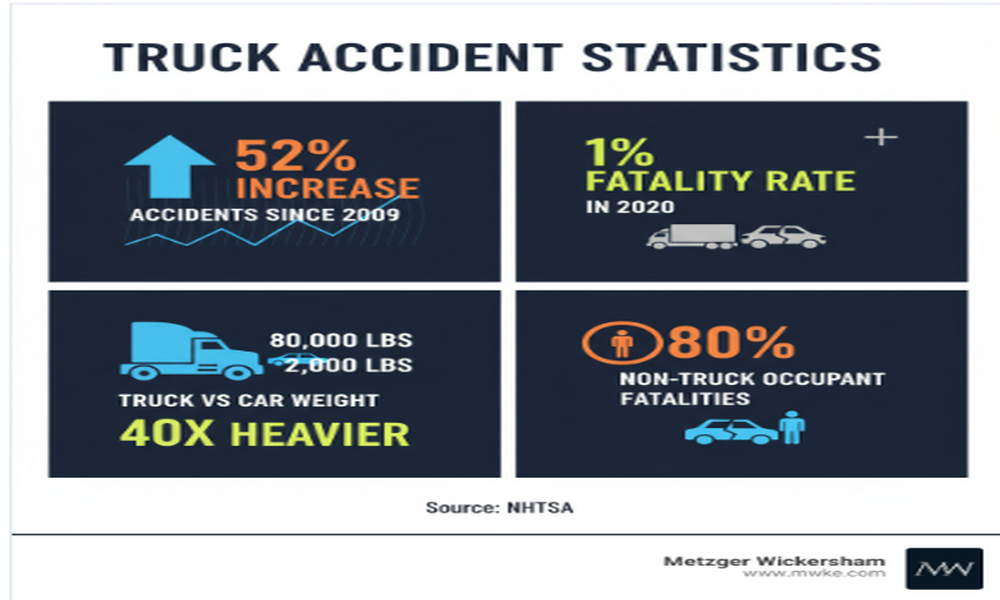
When you’re hit by a truck, the situation is far more complex than a typical car accident. The differences are stark and significantly impact the severity and legal handling of the case. The primary difference is the massive size and weight disparity. A commercial truck can weigh up to 80,000 pounds, compared to a 4,000-pound passenger car. This force means injuries are often catastrophic, including traumatic brain injuries, spinal cord damage, and internal injuries. Statistics show that over 80 percent of fatalities in large truck crashes are occupants of other vehicles. Another key difference is complex liability. In a car accident, liability is usually between drivers. In a truck accident, there can be multiple at-fault parties, including: - The truck driver
- The trucking company
- Cargo loaders
- Vehicle manufacturers or maintenance crews
Common Causes of Truck Collisions
Understanding the common causes of truck accidents highlights the many risk factors on the road.- Driver Error: Distracted driving, speeding, and general inattention are leading causes. A speeding truck requires significantly more distance to stop.
- Driver Fatigue: Despite federal rules, drivers are often pressured to meet tight deadlines, leading to drowsy driving, which can be as dangerous as drunk driving.
- Intoxication: Truck drivers are held to a stricter blood alcohol limit (0.04) than other drivers.
- Improper Cargo Loading: Unsecured or poorly balanced freight can cause a truck to become unstable, jackknife, or roll over.
- Poor Vehicle Maintenance: Neglecting brake inspections, tire replacements, and other critical maintenance can lead to equipment failure.
- Blind Spots: Large trucks have significant blind spots (“No-Zones”) that can easily hide a passenger car from the driver’s view.
The Role of Federal Trucking Regulations
The trucking industry is governed by a complex set of federal rules from the Federal Motor Carrier Safety Administration (FMCSA). Violations of these regulations often become key evidence in accident cases.- Hours of Service (HOS) Rules: These rules limit driving hours and mandate rest breaks to combat driver fatigue. Driver logs track compliance.
- Driver Qualification Files (DQF): Companies must maintain these files, which include a driver’s training records, driving history, and medical certifications. You can learn more about these requirements through the Driver Qualification File guidelines.
- Drug and Alcohol Testing: Mandatory testing is required, including post-accident screening.
- Vehicle Inspection and Maintenance: Federal law requires stringent inspections and detailed maintenance records.
Navigating the Legal Process and Your Claim
After being hit by a truck, you enter a complex legal world where the insurance company’s primary goal is to protect its bottom line, not to help you. Dealing with insurance companies after a truck accident is challenging. Their adjusters and lawyers work to minimize payouts. They may contact you quickly for a recorded statement, hoping to use your words against you later. Seemingly innocent questions are designed to get you to downplay your injuries. Commercial trucks have higher liability limits (typically $750,000 to $5 million), which means aggressive insurance adjusters will fight even harder. They may delay your claim, question your injuries, or try to blame you for the crash. This is why the role of a truck accident lawyer is so critical. At Metzger Wickersham, with offices across Pennsylvania and in Frederick, MD, we have over 135 years of experience dealing with these companies. Our team handles the investigation and all communication with insurers, allowing you to focus on healing. We gather evidence, consult with reconstruction specialists, and negotiate for a fair settlement. While most cases settle out of court, we are always prepared for trial.What Damages Can Be Recovered if You Were Hit by a Truck?
The law allows you to seek compensation for both financial losses and the non-tangible ways the accident has affected your life. Economic damages cover calculable losses:- Medical expenses: Current and future costs for treatment, surgery, therapy, and long-term care.
- Lost wages: Income lost while you are unable to work.
- Loss of earning capacity: Compensation if your injuries prevent you from returning to your previous job or earning potential.
- Property damage: The cost to repair or replace your vehicle and other personal items.
- Pain and suffering: Compensation for the physical pain and emotional distress you have endured.
- Emotional distress: For psychological impacts like anxiety, depression, or PTSD resulting from the trauma.
- Loss of enjoyment of life: For the inability to participate in hobbies and activities that once brought you joy.
Crucial Evidence Your Lawyer Will Investigate
Building a strong case requires a thorough investigation into evidence that is unique to trucking accidents.- Truck’s black box data: The Event Data Recorder (EDR) captures speed, braking, and other data from the moments before a crash.
- Electronic logging devices (ELDs): These automatically record a driver’s hours, revealing potential fatigue or HOS violations.
- Driver’s logbooks: These show the driver’s recent activity and rest periods.
- Driver Qualification File (DQF): This file contains the driver’s training, medical, and driving records. Details are outlined in the Driver Qualification File guidelines.
- Company records: Hiring, training, and safety policies can reveal corporate negligence.
- Post-accident drug test results: These are often mandatory and can be critical evidence.
- Maintenance and repair records: These show whether the truck was in safe operating condition.
Frequently Asked Questions About Truck Collisions
If you’ve been hit by a truck, you likely have many questions about the legal process. Here are answers to some of the most common ones.How long do I have to file a claim in Pennsylvania?
Pennsylvania’s statute of limitations sets strict deadlines for filing a lawsuit.- Personal Injury: You have two years from the date of the accident to file a claim for your injuries, including medical bills, lost wages, and pain and suffering.
- Property Damage: You have four years to file a claim for damage to your vehicle or other property.
Can I sue the trucking company in addition to the driver?
Yes. This is a key difference in truck accident cases. You can often hold multiple parties responsible.- Vicarious Liability: The legal doctrine holding an employer responsible for the actions of their employee. If the driver was on the job, the company can be held liable.
- Direct Liability: The company can also be sued directly for its own negligence, such as:
- Negligent hiring: Employing drivers with poor safety records.
- Inadequate training: Failing to properly train drivers on safety procedures.
- Failure to maintain vehicles: Cutting corners on maintenance for brakes, tires, and other critical parts.
- Pressuring drivers to violate HOS rules: Forcing drivers to work beyond legal limits to meet deadlines.
How do insurance companies handle truck accident claims?
Insurance companies treat truck accident claims as high-stakes battles. When you’re hit by a truck, you face a much more complex and aggressive process.- Multiple Insurance Policies: A claim can involve the trucking company’s insurer, the driver’s personal policy, and separate policies for the trailer or cargo.
- Aggressive Defense Tactics: Insurers deploy investigators immediately to find evidence that can be used to deny or reduce your claim.
- Higher Policy Limits: With policies ranging from $750,000 to $5,000,000, insurers fight much harder to avoid paying out.
- Complex Negotiations: Insurers often use delay tactics, hoping you will accept a lowball settlement out of desperation. They will challenge your medical records and try to shift blame.
- Attempts to Minimize Payouts: A common tactic is to offer a quick settlement before the full extent of your injuries and future costs are known. They will also argue that your injuries are pre-existing or not as severe as you claim.

