Can you sue with limited tort in PA: Ultimate 2025 Guide
When Pennsylvania’s Limited Tort Still Allows You to Sue
Can you sue with limited tort in PA? Yes. Your ability to recover compensation for pain and suffering, however, depends on meeting specific legal exceptions under Pennsylvania law.
Quick Answer: Your Right to Sue with Limited Tort
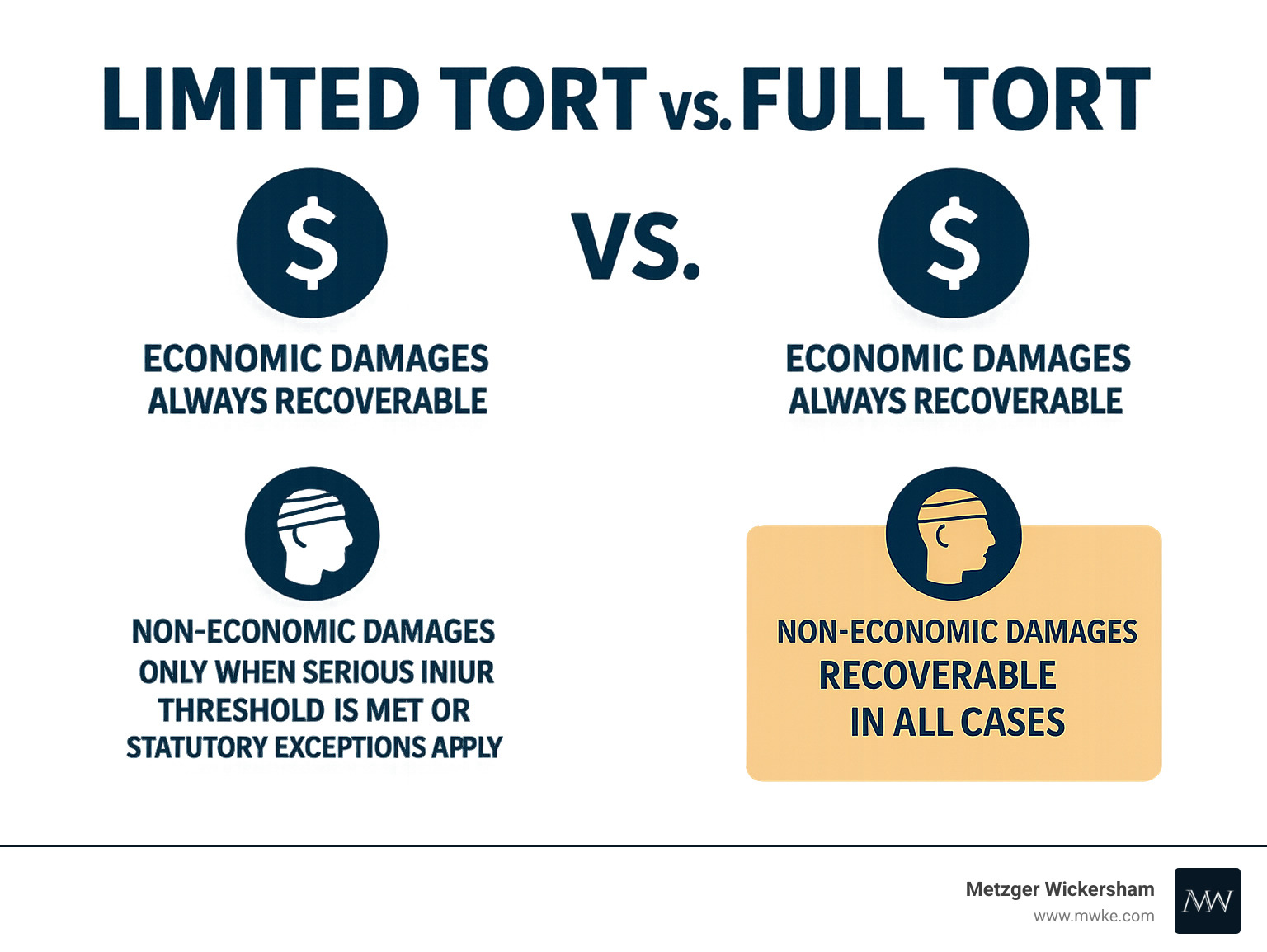
You can always sue for economic damages like medical bills, lost wages, and property damage.
You can sue for pain and suffering if:
Your injury meets the “serious injury” standard (death, permanent disfigurement, or serious impairment of body function).
The at-fault driver was convicted of DUI or accepted ARD.
The at-fault driver’s vehicle is registered out-of-state.
You were a pedestrian, bicyclist, or in a commercial vehicle.
Many Pennsylvania drivers choose limited tort coverage to save on insurance premiums. After an accident, however, the restrictions of this choice become clear. Limited tort doesn’t eliminate your right to sue, but it restricts recovery for non-economic damages like pain and suffering. Fortunately, Pennsylvania law provides crucial exceptions that can restore your full legal rights. Understanding these exceptions is the key to recovering fair compensation for the true impact of your injuries.
Understanding the Basics: Limited Tort vs. Full Tort in Pennsylvania
When choosing car insurance in Pennsylvania, the “tort option” you select can dramatically impact your life after an accident. Pennsylvania’s Motor Vehicle Financial Responsibility Law (MVFRL) gives drivers a choice between full tort and limited tort coverage.
This decision primarily affects your ability to recover non-economic damages—the legal term for pain and suffering. These are the invisible wounds, like chronic pain or anxiety, that don’t come with a receipt. In contrast, economic damages are your tangible financial losses, such as medical bills, lost wages, and property damage. The good news is that can you sue with limited tort in PA for economic losses? Yes. You can always pursue compensation for your financial losses, regardless of your tort choice.
What is Limited Tort Coverage?
Choosing limited tort means you agree to give up most of your rights to sue for pain and suffering in exchange for lower premiums, often around 15% less. If you’re hurt in an accident that wasn’t your fault, you’re waiving your rights to seek compensation for non-economic damages unless your injuries are considered “serious” under Pennsylvania law or certain exceptions apply. While your medical bills and lost wages are covered, compensation for the physical pain and emotional trauma that disrupts your daily life is restricted unless you can prove your injury crosses that “serious” threshold.
What is Full Tort Coverage?
Full tort coverage costs more in premiums but preserves your unrestricted right to sue for all damages—both economic and non-economic—regardless of how “serious” your injuries are. If someone’s negligence causes an injury like whiplash that results in months of discomfort, full tort allows you to seek full compensation for all damages without meeting a legal standard of severity. Many drivers find the peace of mind from this greater protection worth the extra cost.
The Financial Implications of Your Tort Choice
Your tort choice comes down to risk tolerance: short-term savings versus long-term protection. A seemingly minor accident can cause chronic pain, but with limited tort, if the injury isn’t deemed “serious,” you may not be compensated for that suffering. Making an informed decision means understanding what you give up with limited tort and, more importantly, knowing the crucial exceptions that can restore your full legal rights.
The ‘Serious Injury’ Threshold: A Major Exception to Limited Tort
Even with limited tort coverage, you can sue for pain and suffering if your injury meets Pennsylvania’s definition of a “serious injury.” This is a major exception for anyone wondering can you sue with limited tort in PA.
However, Pennsylvania law § 1702 sets a high bar to prevent lawsuits over minor bumps and bruises. Insurance companies will interpret the “serious injury” definition as narrowly as possible to limit payouts. If your case goes to trial, a jury has the final say, and while they are often more understanding of what constitutes real suffering than an insurance adjuster proving “serious injury” to a jury is still a huge hurdle.
What Qualifies as a ‘Serious Injury’ in PA?
Pennsylvania law defines a serious injury in three categories:
Death: The most tragic and obvious qualifier.
Permanent serious disfigurement: Injuries that permanently and significantly alter your appearance, not just a small, fading scar.
Serious impairment of body function: This is the most contested category. It means the injury has significantly affected your body’s ability to function normally. A herniated disc that prevents you from lifting your children or sleeping through the night might qualify.
You can read the exact text in Pennsylvania’s legal code under 75 Pa. C.S. § 1702, but courts interpret it on a case-by-case basis. They consider the duration of the impairment, the body functions affected, the required treatment, and how the injury has impacted your life.
How to Prove Your Injury Meets the ‘Serious’ Standard
Proving a “serious” injury requires a strong foundation of evidence:
Medical documentation: Every doctor’s visit, diagnosis, and treatment plan tells the story of your injury. Do not skip appointments, as insurance companies use gaps in treatment to argue an injury isn’t severe.
Diagnostic tests: MRIs, X-rays, and CT scans provide hard-to-dispute visual evidence of injuries like herniated discs or torn ligaments.
Consistent medical treatment: Following your doctor’s orders and attending physical therapy demonstrates that your injuries are real and ongoing.
A daily journal: Documenting your pain and limitations provides a personal account of how the injury affects your sleep, work, relationships, and daily tasks. This gives a human face to your medical records.
This evidence must be combined with strong legal arguments that connect your situation to Pennsylvania’s legal definition of serious injury. An experienced attorney knows how to present your story in a way that courts will understand.
Can You Sue with Limited Tort in PA? Opening up Other Key Exceptions
Even if your injury doesn’t meet the “serious injury” threshold, Pennsylvania law includes several other important exceptions that can restore your right to sue for pain and suffering. These statutory exceptions often depend on the at-fault driver’s actions or the circumstances of the accident.
When the At-Fault Driver’s Actions Waive Your Limited Tort Status
Certain dangerous or illegal behaviors by the at-fault driver can override your limited tort restrictions, preventing them from avoiding full responsibility.
Drunk Driving: Your limited tort status is waived if the at-fault driver is convicted of DUI, pleads guilty, or accepts Accelerated Rehabilitative Disposition (ARD) for the accident. An arrest or charge is not enough; the legal process must conclude.
Exceptions Based on the Vehicle or Your Status
Your ability to sue with limited tort in PA can also depend on the vehicles involved or your role in the accident.
Out-of-State Vehicles: If the car that hit you is registered in another state, your limited tort restrictions usually don’t apply.
Commercial Vehicles: If you were injured while in a taxi, Uber, Lyft, bus, or work vehicle, your claim is typically not restricted by your limited tort status.
Motorcyclists, Pedestrians, and Bicyclists: Limited tort restrictions from your auto policy typically do not apply if you were injured while on a motorcycle, walking, or riding a bicycle.
How to know if you can sue with limited tort in PA
Determining if an exception applies requires careful investigation. This involves reviewing the police report for details on the vehicles and any charges filed. We also perform vehicle registration verification to check for out-of-state plates. A thorough legal investigation uncovers the facts that can restore your full legal rights. Our team can help you understand how these complex rules apply to your situation; you can find more information about car accident claims on our website.
What to Do After an Accident with Limited Tort Insurance
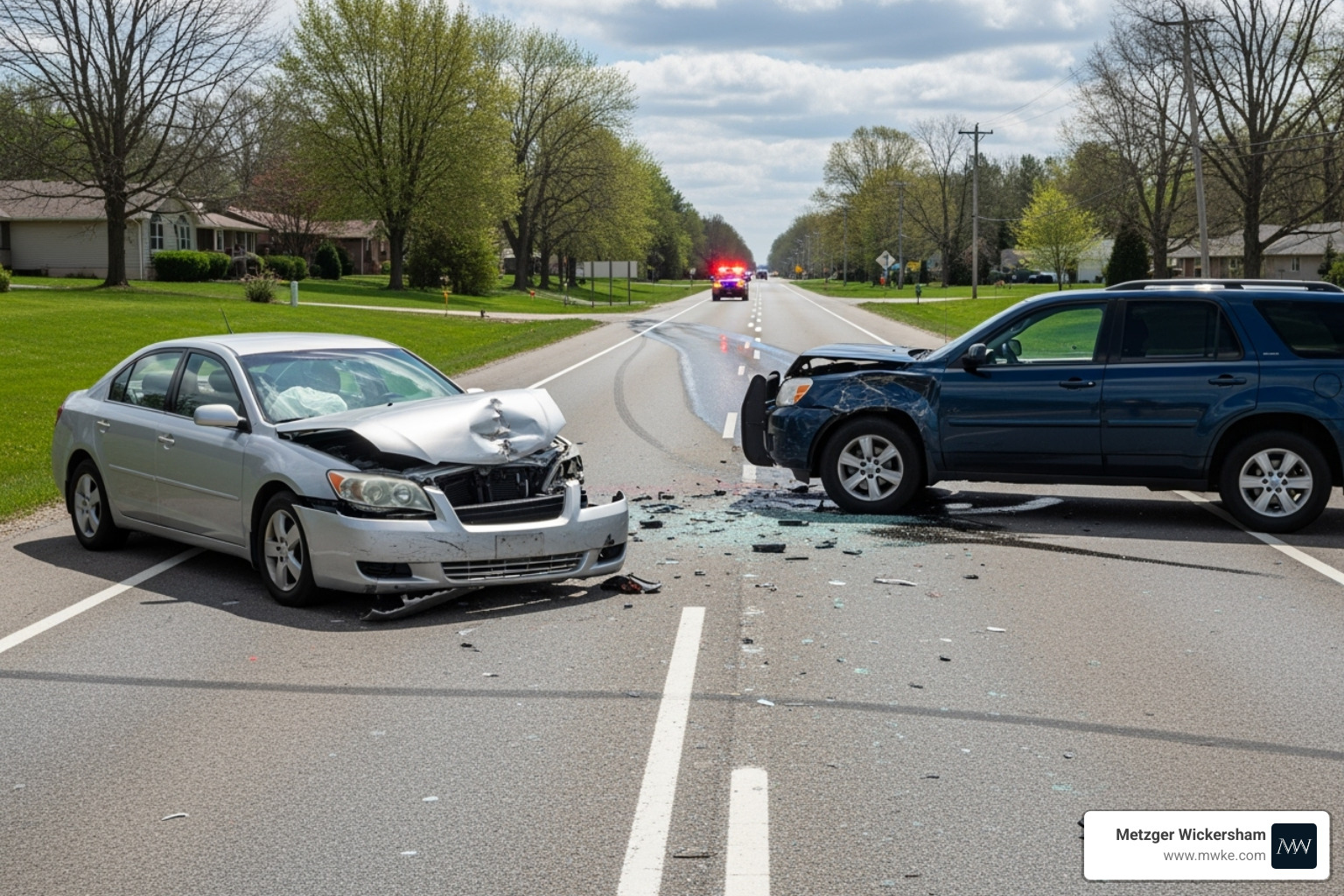
The steps you take in the moments and days after a car accident can make a significant difference in whether you can sue with limited tort in PA for fair compensation. Accidents are overwhelming, but taking the right actions protects your future.
Your First Steps at the Accident Scene
Adrenaline can mask serious injuries, and important details can be forgotten quickly. Take these steps immediately:
Call 911: An official police report is a crucial record, especially if there are injuries or significant damage.
Don’t apologize: A simple “I’m sorry” can be twisted into an admission of fault. Stick to the facts.
Exchange information: Get the other driver’s name, contact info, driver’s license number, and insurance details, including the license plate number.
Take photos: Document everything—vehicle damage from all angles, the final positions of the cars, skid marks, traffic signs, road conditions, and any visible injuries. Photos are powerful evidence.
Get witness information: The contact details of any neutral witnesses can be invaluable if there’s a dispute about fault.
Why You Must Seek Prompt Medical Attention
Many people make a costly mistake by not seeing a doctor right away. Adrenaline can hide symptoms of injuries like whiplash or concussions for hours or even days.
Seeking prompt medical care is vital for two reasons. First, it’s essential for your health. Second, it creates an official record of your injuries. With limited tort, you might need to prove your injury is “serious,” and medical records provide the necessary objective evidence. If you wait weeks to see a doctor, an insurance company will likely argue your injuries weren’t caused by the accident. Don’t give them that opportunity. The Mayo Clinic provides useful guidance on symptoms to watch for after an accident.
How a Lawyer Helps Steer Your Limited Tort Claim
Insurance law is complex, especially with limited tort restrictions. At Metzger Wickersham, we have helped Pennsylvania accident victims for over 135 years and understand the nuances of limited tort law.
We begin with a thorough case evaluation to review your injuries, your policy, and the accident details. We investigate whether any limited tort exceptions apply, such as an out-of-state driver or a DUI charge, which can completely change your case. If no exception applies, we work with your medical team to gather evidence to prove your injury meets the “serious injury” threshold.
We handle all communications with insurance companies, protecting you from adjusters trained to minimize payouts. If necessary, we’re prepared to take your case to court. Our dedicated team approach ensures you have experienced advocates fighting for you. Having limited tort doesn’t mean you’re out of options; with the right legal guidance, you may still be able to pursue the compensation you deserve.
Frequently Asked Questions About Suing with Limited Tort in PA
It’s natural to have questions about your rights when you have limited tort coverage. Here are answers to some of the most common questions we’ve encountered in our 135+ years of practice.
How does limited tort affect the statute of limitations?
In Pennsylvania, you typically have two years from the date of an accident to file a personal injury lawsuit. This is a strict deadline. However, with limited tort, there is a legal concept known as the “findy rule.” Some courts have suggested that the two-year clock might not start until you find that your injury meets the “serious injury” threshold.
For example, a minor back strain might later be diagnosed as a chronic condition, which is when you truly “find” the serious nature of your injury. Pennsylvania courts have addressed this concept in cases like Walls v. Scheckler and Varner-Mort v. Kapfhammer.
Despite this rule, don’t gamble with time. Rules are always subject to change. It is always safer to act quickly. Evidence can be lost, and witness memories fade. The sooner you speak with a legal team, the better your rights can be protected.
Can my passengers sue for pain and suffering if I have limited tort?
This depends on the passenger’s relationship to you. A resident relative (someone living in your household related by blood, marriage, or adoption) is generally bound by your limited tort selection. They face the same restrictions on suing for pain and suffering.
However, a passenger who is not a resident relative, such as a friend or coworker, is not bound by your choice. Keep in mind though that they are bound by the choice they made on their own car insurance policy or the choice made on the policy of a resident relative. . All exceptions, like the serious injury threshold or a drunk driver, still apply to everyone in the vehicle.
Can I switch from limited tort to full tort coverage?
Yes, you can contact your insurance company at any time to switch to full tort coverage. Many people make this change after realizing how restrictive limited tort can be. The peace of mind from full tort coverage is often worth the extra cost, which is usually around 15% more in premiums.
Any change only applies to future accidents. Your tort choice is locked in based on the coverage you had at the time of the crash. We recommend reviewing your auto insurance coverage annually, as your life circumstances and risk tolerance can change.
Conclusion
So, can you sue with limited tort in PA? The answer is “yes,” but your path to compensation requires understanding the specific rules. Limited tort doesn’t close the courthouse door; it just means you need the right key to open it.
Remember these key points: You can always pursue economic damages like medical bills and lost wages. For pain and suffering, your success depends on meeting Pennsylvania’s “serious injury” threshold or qualifying for a statutory exception, such as the at-fault driver being from out-of-state or convicted of DUI.
The 15% savings on your insurance bill might seem appealing, but the complexity of Pennsylvania’s auto insurance laws can have far-reaching consequences after an accident. Dealing with these legal issues while recovering from an injury can be overwhelming.
That’s why our team at Metzger Wickersham is here to help. With over 135 years of experience handling these situations, we understand the nuances of Pennsylvania’s limited tort system. Our dedicated team approach means you get the combined knowledge and commitment of our entire firm.
We will review your case, investigate every possible exception, and fight for the compensation you deserve. To learn more about how we handle car accident cases and how we can help you, please visit our website. We are ready to help you understand your options.
 Skip to content