Statute of limitations for medical malpractice in pennsylvania 2025
Navigating Pennsylvania’s Medical Malpractice Deadlines
The statute of limitations for medical malpractice in Pennsylvania gives you a limited window to file your claim after suffering harm from medical negligence. Understanding these deadlines is crucial because missing them means losing your right to seek compensation forever.
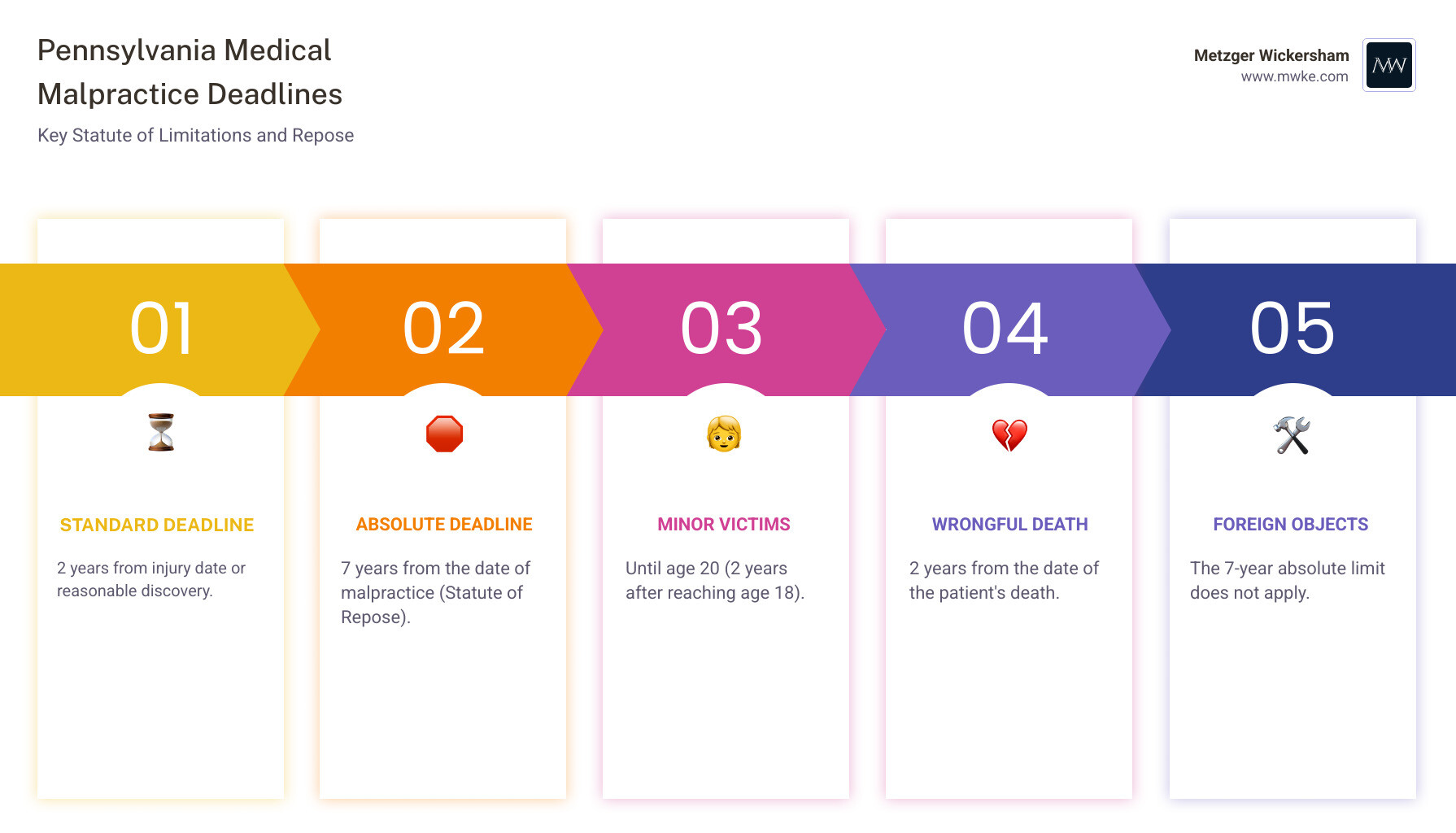
Pennsylvania Medical Malpractice Filing Deadlines:
Standard deadline: 2 years from date of injury or discovery of an injury
Absolute deadline: 7 years from date of malpractice (statute of repose)
Minor victims: Until age 20 (2 years after turning 18)
Wrongful death: 2 years from date of death
Foreign objects: No 7-year limit applies
When medical professionals fail to provide proper care, the physical pain is just the beginning. You’re facing mounting medical bills, lost wages, and emotional distress. But there’s something else working against you that you might not know about – the clock is ticking on your legal rights.
Pennsylvania law sets strict deadlines for filing medical malpractice lawsuits. These time limits exist to balance your right to seek justice with the need to resolve legal disputes while evidence and memories are still fresh.
The complexity of these rules means that what seems like a simple two-year deadline actually has many exceptions and nuances. Some situations can extend your time to file, while others can cut it short. Missing these deadlines doesn’t just delay your case – it eliminates it entirely.
The Standard Two-Year Filing Window in Pennsylvania
When it comes to medical malpractice claims in Pennsylvania, time isn’t just money—it’s everything. The statute of limitations for medical malpractice in Pennsylvania gives you a standard two-year window to file your lawsuit, as outlined in 42 Pa. Cons. Stat. § 5524(2).
This two-year period covers personal injury claims arising from wrongful acts, neglect, or negligence by healthcare providers. Whether you’re dealing with a botched surgery, delayed diagnosis, or medication error, this timeline applies to your situation.
Here’s the thing many people don’t realize: two years sounds like plenty of time when you’re in the middle of recovery, but it disappears faster than you’d expect. Between managing your health, dealing with insurance companies, and trying to get your life back on track, months can slip by without you even thinking about legal action.
That’s why taking prompt action matters so much. The sooner you start documenting what happened and exploring your legal options, the stronger your case becomes. Evidence stays fresh, witnesses remember details clearly, and medical records are easier to obtain. If you’re wondering where to start, our guide on Navigating Medical Negligence: How to Choose a Medical Malpractice Lawyer can point you in the right direction.
When Does the Two-Year Clock Officially Start?
This is where things get interesting—and sometimes complicated. The statute of limitations for medical malpractice in Pennsylvania doesn’t always start ticking on the same day for everyone.
In straightforward cases, the clock begins on the date of the wrongful act or negligent conduct. If a surgeon leaves a sponge in your abdomen during an operation and you develop immediate complications, the timeline starts when that surgery happened. Same goes for obvious surgical errors or clear misdiagnosis situations where the harm is apparent right away.
But medical malpractice isn’t always so black and white. Sometimes the damage from negligent care doesn’t show up for months or even years. Think about a radiologist who misreads a scan and misses early signs of cancer. You might not realize anything was wrong until the cancer has progressed significantly.
Pennsylvania recognizes this unfair situation through what’s called the “discovery rule.” Under this rule, the two-year clock starts when you knew—or reasonably should have known—that you were injured and that someone else’s conduct caused that injury.
The key phrase here is “reasonably should have known.” This doesn’t mean you need to be a medical professional who can diagnose malpractice on your own. It means the law expects you to pay attention to warning signs that a reasonable person in your situation would notice.
What Happens if You Miss the Deadline?
Let’s be completely honest about this: missing the deadline is devastating, and there’s usually no coming back from it.
When you file your lawsuit even one day after the statute of limitations for medical malpractice in Pennsylvania expires, the court will dismiss your case. It doesn’t matter how clear the malpractice was, how much you’ve suffered, or how strong your evidence is. The judge won’t even look at the merits of your claim.
This dismissal is permanent. You lose your legal right to seek compensation forever. All those medical bills, lost wages, pain and suffering, and future care needs? You’ll have to handle them on your own.
The court system is strict about these deadlines because they serve an important purpose. They ensure that cases are filed while evidence is still available and memories are fresh. But from your perspective as someone who’s been harmed, these deadlines can feel harsh and unforgiving.
This is exactly why we can’t stress enough the importance of getting legal consultation as soon as you suspect something went wrong with your medical care. Don’t wait until you’re “sure” about malpractice—that’s what lawyers and medical professionals are there to help you figure out.
Every day that passes brings you closer to losing your rights permanently. If you’re dealing with potential malpractice, time is working against you. For a deeper dive into how these deadlines work and why they matter, check out our detailed explanation in Understanding the Statute of Limitations in Medical Malpractice Cases: A York Medical Malpractice Lawyer Explains.
Exceptions That Can Extend Your Filing Time
Pennsylvania law understands that medical mistakes don’t always announce themselves with flashing lights. Sometimes, the harm from negligence stays hidden for months or even years. That’s why there are important exceptions that can extend the statute of limitations for medical malpractice in Pennsylvania beyond the standard two-year window.
These exceptions “toll” the statute of limitations, which is legal speak for pausing or extending the deadline. Think of it like hitting the pause button on a stopwatch – the clock stops ticking until certain conditions are met.
The most common situations that can extend your filing time include cases where you couldn’t reasonably have known about the injury (called the “findy rule”), situations involving children who were harmed, and instances where a healthcare provider deliberately hid their mistake. Each situation has its own specific rules and requirements.
What makes this tricky is that every case is different. What looks like a clear exception to you might not meet the strict legal requirements, or you might have an exception you didn’t even know existed. That’s why getting a thorough case analysis from someone who understands these nuances is so important.
The Discovery Rule: When You Couldn’t Have Known
The discovery rule is perhaps the most important exception to the standard two-year statute of limitations for medical malpractice in Pennsylvania. This rule recognizes a simple truth: you can’t file a lawsuit about an injury you don’t know exists.
Under this rule, your two-year clock doesn’t start ticking until you find your injury and realize it might have been caused by medical negligence. But here’s the key part – it’s not just about when you actually figure it out. The law asks when a reasonable person, using reasonable diligence, would have found the problem.
Let’s say you had surgery three years ago and everything seemed fine. Recently, though, you’ve been having unexplained pain and complications. A new doctor reviews your case and finds that a crucial step was skipped during your original surgery, directly causing your current problems. The discovery rule would likely apply here because you had no way of knowing about the surgical error when it happened.
The rule covers situations like hidden injuries that develop over time, misread test results that led to delayed or wrong treatment, and other forms of negligence that aren’t immediately obvious. The purpose of the discovery rule, as courts have explained, is to prevent the unfair situation where someone loses their right to seek justice before they even know they were wronged.
But there’s an important catch – you can’t just ignore symptoms or avoid seeking medical opinions and then claim you didn’t know. Courts will look at whether you acted reasonably in trying to understand your condition. If you’re dealing with a situation where the discovery rule might apply, it’s worth exploring how to find a medical malpractice lawyer who can help you understand your options.
Special Rules for Minors Harmed by Malpractice
Children get extra protection under Pennsylvania law, and for good reason. Kids can’t file lawsuits on their own, and they often don’t understand what happened to them or why. That’s why the statute of limitations for medical malpractice in Pennsylvania has special rules for minors.
If a child is harmed by medical negligence, the two-year clock generally doesn’t start running until they turn 18. This means they have until their 20th birthday to file a lawsuit – two years after reaching adulthood.
This extended deadline makes perfect sense when you think about it. A baby who suffers a birth injury can’t exactly march into a law office and demand justice. Even older children might not understand that their ongoing health problems were caused by a doctor’s mistake years earlier.
This rule is especially crucial for birth injuries and pediatric malpractice cases where the full impact of the harm might not become clear for many years. For instance, a child who suffers nerve damage during delivery might not fully understand how this affects their life until they’re much older. Our firm has handled complex cases involving conditions like brachial plexus injuries that can have lifelong consequences.
The law recognizes that parents are doing their best to care for their injured child, and they shouldn’t be penalized if they don’t immediately realize that medical negligence was involved. This extended timeline gives families the breathing room they need to understand what happened and seek appropriate legal action when the time is right.
The Absolute Deadline: Pennsylvania’s Statute of Repose
Pennsylvania’s medical malpractice law has undergone significant changes regarding absolute time limits for filing claims. For years, the state’s Medical Care Availability and Reduction of Error (MCARE) Act included what’s called a “statute of repose” – a hard deadline that acted as the final word on when you could file a medical malpractice lawsuit.
This statute of repose traditionally set a seven-year absolute limit from the date the alleged malpractice occurred, regardless of when you finded the injury. The reasoning was straightforward: at some point, there needs to be finality. Medical providers shouldn’t have to worry about lawsuits decades after an incident, when witnesses have scattered, memories have faded, and medical records might be lost or destroyed.
However, there’s been a major legal development that changes everything. In 2019, the Pennsylvania Supreme Court declared the statute of repose unconstitutional. This landmark ruling means that the traditional seven-year cutoff no longer applies in many situations.
What does this mean for your case? If you can prove that you genuinely could not have finded the malpractice within the seven-year timeframe, your claim might still be viable even years later. This is particularly important for cases involving hidden injuries or situations where medical providers concealed their mistakes.
Despite this ruling, understanding the historical context remains crucial. Some legal references still mention the seven-year rule, and the distinction between statutes of limitations and statutes of repose helps explain Pennsylvania’s complex legal landscape. You can review the original MCARE Act for historical context, and the specific wording of the now-unconstitutional statute of repose can be found in Pennsylvania Statutes Title 40 P.S. Insurance § 1303.513.
Statute of Limitations vs. Statute of Repose
Even though Pennsylvania’s statute of repose has been declared unconstitutional, understanding the difference between these two legal concepts helps clarify how the statute of limitations for medical malpractice in Pennsylvania works:
The statute of limitations focuses on fairness – it starts the clock when you reasonably could have known about the injury. The statute of repose, on the other hand, was designed to provide absolute finality, regardless of when the injury was findable.
Think of it this way: the statute of limitations protects patients who couldn’t reasonably know they were harmed, while the statute of repose was meant to protect healthcare providers from indefinite legal exposure. With the statute of repose now unconstitutional, the balance has shifted more toward protecting patients’ rights to seek justice.
Are There Exceptions to the Statute of Repose?
While Pennsylvania’s general statute of repose has been declared unconstitutional, it’s worth understanding what exceptions existed when it was in effect, as these principles still influence how courts approach older cases.
The most significant exception involved foreign objects left in the body during surgery. If a surgeon accidentally left a sponge, surgical instrument, or other foreign object inside you, the seven-year limit traditionally didn’t apply. These cases were considered so egregious that the law recognized they deserved different treatment.
Claims by minors also received special consideration. Since children can’t file lawsuits on their own behalf and may not understand the significance of medical errors until they’re older, their cases often fell outside the rigid seven-year rule.
The concept of fraudulent concealment was another important exception. If a healthcare provider actively hid their mistake or lied about what happened, courts would often find that the statute of repose shouldn’t protect them from the consequences of their deception.
Understanding these historical exceptions helps explain why the Pennsylvania Supreme Court ultimately found the statute of repose problematic – it created unfair barriers for legitimate claims while sometimes protecting negligent providers who had concealed their errors.
 Skip to content

 Pennsylvania recognizes this unfair situation through what’s called the “discovery rule.” Under this rule, the two-year clock starts when you knew—or reasonably should have known—that you were injured and that someone else’s conduct caused that injury.
The key phrase here is “reasonably should have known.” This doesn’t mean you need to be a medical professional who can diagnose malpractice on your own. It means the law expects you to pay attention to warning signs that a reasonable person in your situation would notice.
Pennsylvania recognizes this unfair situation through what’s called the “discovery rule.” Under this rule, the two-year clock starts when you knew—or reasonably should have known—that you were injured and that someone else’s conduct caused that injury.
The key phrase here is “reasonably should have known.” This doesn’t mean you need to be a medical professional who can diagnose malpractice on your own. It means the law expects you to pay attention to warning signs that a reasonable person in your situation would notice.
 These exceptions “toll” the statute of limitations, which is legal speak for pausing or extending the deadline. Think of it like hitting the pause button on a stopwatch – the clock stops ticking until certain conditions are met.
The most common situations that can extend your filing time include cases where you couldn’t reasonably have known about the injury (called the “findy rule”), situations involving children who were harmed, and instances where a healthcare provider deliberately hid their mistake. Each situation has its own specific rules and requirements.
What makes this tricky is that every case is different. What looks like a clear exception to you might not meet the strict legal requirements, or you might have an exception you didn’t even know existed. That’s why getting a thorough case analysis from someone who understands these nuances is so important.
These exceptions “toll” the statute of limitations, which is legal speak for pausing or extending the deadline. Think of it like hitting the pause button on a stopwatch – the clock stops ticking until certain conditions are met.
The most common situations that can extend your filing time include cases where you couldn’t reasonably have known about the injury (called the “findy rule”), situations involving children who were harmed, and instances where a healthcare provider deliberately hid their mistake. Each situation has its own specific rules and requirements.
What makes this tricky is that every case is different. What looks like a clear exception to you might not meet the strict legal requirements, or you might have an exception you didn’t even know existed. That’s why getting a thorough case analysis from someone who understands these nuances is so important.

