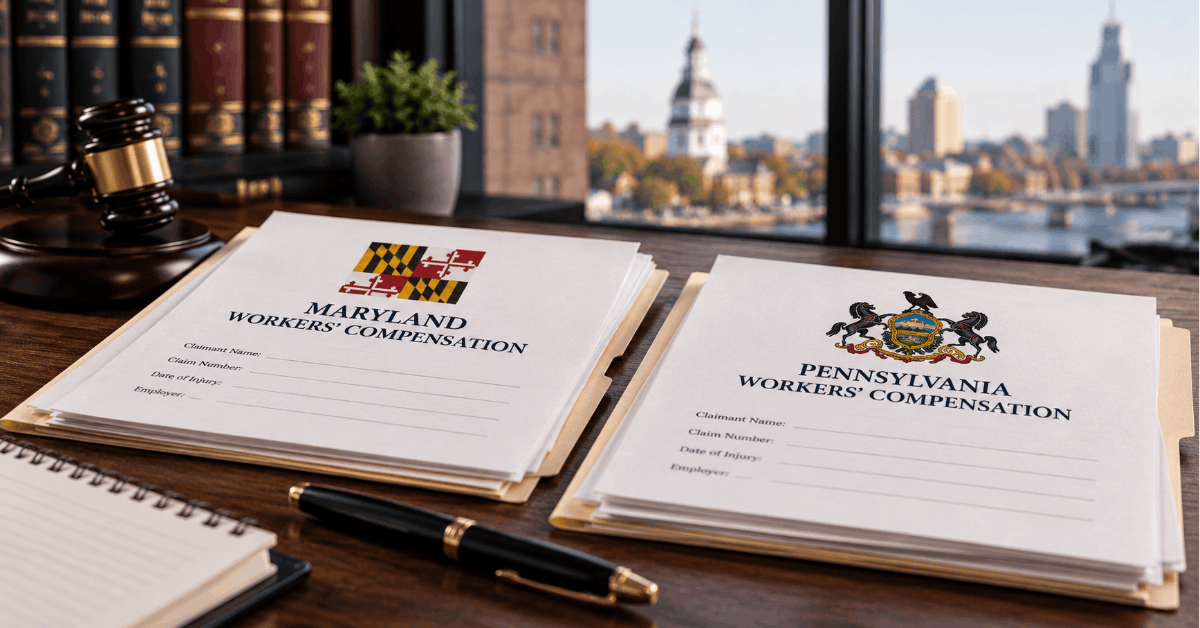
Maryland Workers’ Compensation: How the Claims Process Differs from Pennsylvania
Related Posts
Contact Us
Let Our Team Fight For You

Key Takeaways
- Maryland and Pennsylvania have different workers’ compensation rules governing injury reporting, claim filing, benefits, and disputes.
- Maryland requires injury notification within 10 days, while Pennsylvania uses 21-day and 120-day notice deadlines.
- Maryland employees must file claims with the Workers’ Compensation Commission, while Pennsylvania employees can receive benefits without filing a Claim Petition.
- Maryland generally requires claims within 60 days, while Pennsylvania provides a three-year filing period for disputed claims.
- Maryland allows injured workers to choose their physicians, while Pennsylvania may require treatment through designated providers for 90 days.
- Workers employed across state lines may qualify for benefits under either state’s laws, depending on their employment arrangements.
Maryland and Pennsylvania both have robust workers’ compensation systems, but their rules and guidelines differ in several respects. For example, in Maryland you have to notify your employer of an accidental injury within 10 days, while Pennsylvania follows 21-day and 120-day notice rules. There are also important differences in the claims process itself, which can be difficult to understand if you live in one state but work in the other.
At Metzger Wickersham, we represent injured workers in both states, including employees who live in Pennsylvania but work in Maryland (and vice versa). In this guide, our workers’ compensation attorneys explain how each state’s system works, including filing guidelines, notice requirements, and what to do if you live in one state but work in another.

Understanding Maryland and Pennsylvania Workers’ Compensation Systems
Maryland and Pennsylvania have separate agencies responsible for administering workers’ compensation claims. Although both states provide medical and wage-loss benefits for workplace injuries and occupational illnesses, they operate differently.
Maryland’s Workers’ Compensation Commission
The Maryland Workers’ Compensation Commission (WCC) administers claims under Title 9 of the Maryland Labor and Employment Article. If you’re injured at work and seek a compensation award, you must file an Employee Claim with the Commission. Under § 9-713, your employer or its insurer must begin paying temporary total disability benefits or contest the claim within 21 days after the Commission mails notice of your filing.
If the employer or insurer disputes your entitlement to benefits, the Commission can hold a hearing to examine the evidence and issue a decision. Claims that aren’t contested may proceed without a hearing.
Pennsylvania’s Bureau of Workers’ Compensation
Pennsylvania takes a different approach. Its Bureau of Workers’ Compensation operates within the Department of Labor & Industry, but employers and their insurers handle the initial claims review. After receiving notice of your work-related disability, the employer or insurer has 21 days to accept liability, deny your claim, or begin temporary compensation payments.
If your claim is denied, you can file a Claim Petition with the Workers’ Compensation Office of Adjudication. A workers’ compensation judge then examines the evidence and determines your entitlement to benefits.
As you can see, the main distinction is how claims begin. Maryland requires employees seeking compensation awards to file with the Commission, while Pennsylvania permits employers and insurers to accept claims without an employee-filed petition.
| Feature | Maryland | Pennsylvania |
|---|---|---|
| Administering Agency | Maryland Workers’ Compensation Commission (WCC) | Bureau of Workers’ Compensation, Department of Labor & Industry |
| Governing Law | Maryland Labor and Employment Article, Title 9 | Pennsylvania Workers’ Compensation Act |
| Initial Claim Filing | Employees seeking a compensation award file an Employee Claim with the WCC. | Employees report injuries to their employers. An employee-filed petition isn’t necessary if the claim is accepted. |
| Employer/Insurer Response | Must begin paying temporary total disability benefits or contest the claim within 21 days after the Commission mails notice. | Has 21 days after receiving notice of work-related disability to accept, deny, or begin temporary compensation. |
| Disputed Claims | The WCC may hold a hearing to review the dispute. | Employees can file a Claim Petition with the Office of Adjudication. |
| Decision-Maker | Workers’ Compensation Commissioner | Workers’ Compensation Judge |
| Claims Without Disputes | May proceed without a hearing. | May proceed without an employee-filed Claim Petition. |
Reporting Workplace Injuries: Different Notice Requirements
In both Maryland and Pennsylvania, injured employees must notify their employers of workplace injuries, but the deadlines aren’t the same. As we mentioned earlier, Maryland requires notice within 10 days, while Pennsylvania uses separate 21-day and 120-day notice periods.
Maryland’s 10-Day Notice Rule
Under Maryland Labor and Employment § 9-704, you must notify your employer of an accidental workplace injury within 10 days. You can provide notice orally or in writing. Written notice must include your name, address, and information identifying when, where, and how the injury occurred. If you miss the deadline, the Workers’ Compensation Commission may excuse it if you had a good reason for the delay or if it didn’t interfere with your employer’s or its insurer’s ability to investigate the injury or defend against your claim.
Pennsylvania’s 21-Day and 120-Day Notice Rules
Under Section 311 of the Pennsylvania Workers’ Compensation Act, you must notify your employer of a workplace injury within 21 days to secure compensation from the beginning of the compensable period. If you report the injury after 21 days, compensation isn’t payable for the period before your employer receives notice.
Pennsylvania also imposes a 120-day notice deadline. Failing to meet it prevents you from receiving compensation unless your employer already knew about the injury. However, if you didn’t know that you had an injury or that it might be work-related, the notice periods begin when you discover, or reasonably should have discovered, the injury and its possible connection to your employment. This exception can apply to illnesses that develop gradually or injuries whose relationship to your work isn’t immediately apparent.
Filing a Workers’ Compensation Claim in Maryland vs. Pennsylvania
Reporting your workplace injury is only the first step. You must also follow the filing rules for the state handling your claim.
Filing a Claim in Maryland
Under Maryland Labor and Employment § 9-709, you must file an accidental injury claim with the Commission within 60 days of your injury. You can submit the Employee Claim form through the Commission’s online CompHub system. If you don’t have an attorney, you can also file a paper claim. (Attorneys representing injured workers must file electronically.)
If you received treatment from a physician you selected, you must also submit that physician’s report. The Commission can excuse a filing made after 60 days if the delay didn’t harm your employer’s or insurer’s ability to defend against the claim, or if you had another defensible reason.
However, claims filed after two years are barred, with two exceptions:
- Injuries involving ionizing radiation have a separate two-year deadline measured from the date of disablement or when you first learned the disablement resulted from radiation.
- If fraud or conduct preventing timely filing caused the delay, you have one year from discovering the fraud or from when that conduct ended to file your claim.
If the employer or insurer fails to act within 21 days after the Commission mails notice, the Commission may impose a penalty of up to 20% of the disability payment. The employer or insurer must still begin paying benefits or contest the claim within 30 days of the Commission’s mailing. Failure to meet that deadline without good cause can result in a penalty of up to 40% of the payment. Any penalty assessed under this section is paid to you.
Filing a Claim in Pennsylvania
In Pennsylvania, your employer or its insurer can accept your claim after receiving notice of your injury. Acceptance is documented through a Notice of Compensation Payable or an approved compensation agreement. If the insurer denies your claim, it issues a Notice of Workers’ Compensation Denial.
An insurer can also issue a Notice of Temporary Compensation Payable, allowing it to provide benefits for up to 90 days without admitting liability. If the insurer doesn’t properly stop temporary compensation within the permitted period, the notice converts to a Notice of Compensation Payable.
If your claim is denied, you can file a Claim Petition with the Workers’ Compensation Office of Adjudication through the Workers’ Compensation Automated and Integrated System (WCAIS). You can also file a petition if your employer or insurer fails to accept or deny your claim or begin temporary compensation within the 21-day response period.
Under Section 315 of the Pennsylvania Workers’ Compensation Act, you must file a Claim Petition within three years of your injury if your employer or its insurer hasn’t accepted responsibility for the injury and no workers’ compensation payments have been made. If payments have already been made, the three-year period runs from the most recent one.
Separate rules apply to occupational diseases:
- Under § 315, you must file a Claim Petition within three years after the occupational disease causes disability. If you didn’t know the disease was work-related, the period begins when you knew or reasonably should have known about that connection.
- Your occupational disease must cause disability within 300 weeks (approximately 5 years and 9 months) after your last employment involving exposure to the workplace hazard. Certain claims, including firefighter cancer claims, have different provisions.
Maryland vs. Pennsylvania Workers’ Compensation Filing Deadlines
| Requirement | Maryland | Pennsylvania |
|---|---|---|
| Report an accidental injury to your employer | Within 10 days of the injury | Within 21 days to preserve compensation from the beginning of the compensable period |
| Final employer notification deadline | Late notice may be excused for sufficient reason or lack of prejudice to the employer or insurer | Within 120 days of injury, with exceptions for injuries discovered later |
| File an accidental injury claim | Within 60 days of injury | Three years from injury to file a Claim Petition if compensation hasn’t been established |
| Outer filing deadline for accidental injuries | Two years, with statutory exceptions | Three years, subject to provisions addressing prior compensation payments |
| Occupational disease notification | Within one year after you know or have reason to believe you have an occupational disease | The 21-day and 120-day notice periods apply from disability, with discovery provisions for an unrecognized work-related connection |
| Occupational disease claim filing | Within two years after disablement or death, or actual knowledge of the employment connection; three years for pulmonary dust disease | Three years from disability when the worker knows or should know of its employment connection |
| Occupational disease disability requirement | No equivalent general 300-week rule | Disability must occur within 300 weeks after the last hazardous employment, with statutory exceptions |
Sources: Maryland Labor and Employment §§ 9-704, 9-705, 9-709, and 9-711; Pennsylvania Workers’ Compensation Act §§ 301(c)(2), 311, and 315.
The main difference between the two states is that Maryland requires employees to file claims with the Commission, while Pennsylvania permits employers and insurers to accept claims without an employee-filed petition. In either state, you should keep copies of your filings and insurance correspondence to document your claim.
FAQs About Workers’ Compensation in Maryland vs. Pennsylvania
What If I Live in Pennsylvania but Work in Maryland?
Maryland’s workers’ compensation system applies to employees working in the state. It also protects those who work outside Maryland temporarily. However, certain employees working temporarily in Maryland are exempt if they were hired elsewhere and the following conditions are satisfied:
- You and your employer entered into an employment contract in another state.
- Neither you nor your employer is a Maryland resident.
- The employer has workers’ compensation insurance from another state that protects you while working in Maryland.
- The other state recognizes Maryland’s workers’ compensation provisions for employment extending beyond state borders.
- The other state provides a comparable exemption for Maryland employees and employers temporarily working there.
Pennsylvania’s Workers’ Compensation Act § 305.2 also protects employees injured outside the state. You may qualify if:
- Your employment is based in Pennsylvania; or
- You were hired in Pennsylvania but regularly work across several states (e.g. long distance freight hauling); or
- You were hired in Pennsylvania to work primarily in another state whose workers’ compensation law doesn’t apply to your employer.
The statute also protects employees hired in Pennsylvania to work outside the United States and Canada.
Can You Sue Your Employer for a Workplace Injury in Maryland or Pennsylvania?
Both states generally prohibit employees from suing their employers for injuries compensated through workers’ compensation. However, Maryland Labor and Employment § 9-509 permits lawsuits when an employer deliberately causes your injury or fails to get required workers’ compensation insurance. Pennsylvania’s Workers’ Compensation Act § 303 also limits employer lawsuits, but employees may pursue personal injury claims against negligent third parties, such as equipment manufacturers or contractors (truck drivers, electrical contractors, etc.).
Speak to a Lawyer About Your Maryland or Pennsylvania Workers’ Compensation Claim
Maryland and Pennsylvania have different rules for reporting workplace injuries, filing claims, and appealing denied benefits. Missing a deadline or following the wrong filing procedure can jeopardize your right to compensation. If you live in one state and work in the other, determining which state’s laws apply is another important consideration.
At Metzger Wickersham, we help injured workers in Maryland and Pennsylvania seek the medical and wage-loss benefits they’re entitled to receive. We can review your claim, explain your filing requirements, and represent you in disputes with insurance companies. Contact us today for a free consultation to discuss your workplace injury and your options for pursuing workers’ compensation benefits.
