Third-Party Claims After a Pennsylvania Workplace Accident: When Workers’ Comp Isn’t Enough
Related Posts
Contact Us
Let Our Team Fight For You

Key Takeaways
- Pennsylvania workers injured by a negligent third party may pursue a personal injury claim for damages beyond those available through workers’ compensation.
- Third-party claims can involve negligent contractors, defective machinery, motor vehicle accidents, hazardous property conditions, and outside maintenance companies.
- Workers’ compensation pays medical expenses and partial wage replacement, while third-party claims may also recover damages for pain and suffering, lost earnings, and reduced earning capacity.
- Successful third-party claims require evidence establishing liability, causation, and damages, although product liability claims don’t always need proof of negligence.
- Under Section 319 of the Pennsylvania Workers’ Compensation Act, employers and their insurers can seek reimbursement from third-party settlements for workers’ compensation benefits paid.
- Pennsylvania generally allows two years to file a third-party personal injury lawsuit, and injured workers can pursue these claims while receiving workers’ compensation benefits.
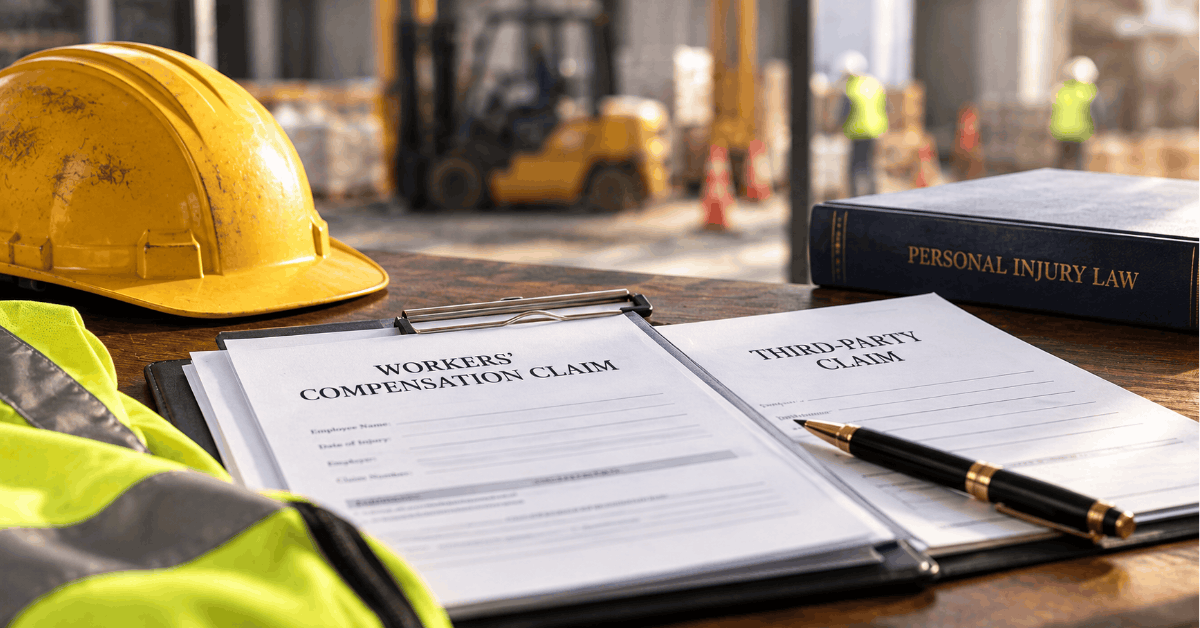
If you’re injured on the job in Pennsylvania, workers’ compensation provides medical benefits and partial wage replacement. In exchange for accepting these benefits, you usually lose the ability to sue your employer directly. But what happens if you were injured by a negligent third party, like a contractor or supplier?
In this situation, you may be able to file a third-party claim after a Pennsylvania workplace accident. In this guide, we’ll explain how third-party claims differ from those for workers’ compensation, what damages you can recover, and how a third-party settlement may affect your existing benefits.

What Is a Third-Party Claim After a Pennsylvania Workplace Accident?
A third-party claim allows you to seek compensation when a person or company other than your employer caused or contributed to your workplace injury. For example, if you’re injured when a contractor’s delivery truck strikes you at a job site, you may have a claim against the driver and the driver’s employer.
Unlike workers’ compensation, which provides benefits without you having to prove employer negligence, third-party claims need evidence of liability in order to succeed. In other words, you have to show that the other party’s negligence caused your injuries.
Why Pennsylvania Workers Can Sue Third Parties but Usually Can’t Sue Their Employers
Under Section 303(a) of the Pennsylvania Workers’ Compensation Act, workers’ compensation is the exclusive remedy against an employer for injuries covered by the Act. This means you ordinarily can’t sue your employer for negligence after a workplace accident. However, Section 303(b) preserves your right to sue a third party responsible for your workplace injury.
Please Note: An exception may apply when you’re injured while working for a subcontractor. Under Sections 302(a) and 302(b), certain contractors are treated as employers for workers’ compensation purposes. These parties may be protected from personal injury lawsuits because they’re legally responsible for providing workers’ compensation benefits if the subcontractor fails to do so.
Common Workplace Accidents That May Support Third-Party Claims
Third-party liability can arise in a wide range of Pennsylvania industries. Your right to pursue compensation depends on who caused your injuries, how their actions contributed to the accident, and whether they’re protected from a lawsuit under Pennsylvania’s workers’ compensation laws.
- Construction Site Accidents: On construction sites, you’ll find several contractors and subcontractors working alongside one another. If an employee of another company causes an accident and leaves you injured, you may have grounds for a third-party claim. For example, if a supplier’s employee drops construction materials from an elevated platform and injures you, the supplier may be liable.
- Defective Machinery and Industrial Equipment: If a defective forklift, industrial press, power tool, or other piece of equipment injures you, you may have a product liability claim against its manufacturer or another responsible company. These claims may involve defective equipment components, unsafe product designs, or inadequate safety warnings. You must establish that the product was defective and that the defect caused your injury.
- Motor Vehicle Accidents During Work: If you’re injured in a traffic accident while performing your job duties, you may have a personal injury claim against the driver who caused the collision. This applies to delivery drivers, truck drivers, and employees travelling between work locations. For example, if another motorist runs a red light and strikes your company vehicle, you may receive workers’ compensation benefits while pursuing damages against the negligent driver.
- Accidents on Property Owned by Third Parties: Employees sometimes work at customer locations, commercial buildings, warehouses, and properties owned by other businesses. If dangerous property conditions cause your injury, you may have a premises liability claim against the responsible property owner or occupier. Examples include falls caused by damaged stairs, unmarked floor hazards, and poorly maintained walkways.
- Negligence by Outside Contractors and Service Providers: Businesses frequently hire outside companies to inspect, repair, install, and maintain workplace equipment. If one of these companies does negligent work that leads to an accident, it may be liable for the resulting injuries. For example, if an independent maintenance company improperly repairs a forklift’s braking system and the brakes fail, injuring you, the maintenance company may face a third-party claim.
What Damages Can You Recover Beyond Workers’ Compensation?
Workers’ compensation pays for medical treatment and replaces part of your lost wages after a work-related injury. However, these benefits don’t cover every loss from your accident. A third-party personal injury claim allows you to pursue further damages from the person or company responsible for your injuries.
What Pennsylvania Workers’ Compensation Pays
Under the Pennsylvania Workers’ Compensation Act, injured employees may receive the following benefits:
- Medical Benefits: Payment for reasonable and necessary medical treatment related to your workplace injury, including surgery, rehabilitation, prescription medications, and medical equipment.
- Wage-Loss Benefits: Payments based on your average weekly earnings before the accident. Benefits are typically calculated at two-thirds of your average weekly wage, although lower-wage employees are subject to different calculations. For injuries occurring in 2026, the maximum weekly payment is $1,394.
- Specific Loss Benefits: Compensation for the permanent loss or loss of use of certain body parts, as well as qualifying permanent facial, head, or neck disfigurement.
- Death Benefits: Payments to eligible surviving dependents when a workplace injury causes an employee’s death.
These benefits don’t include compensation for pain, suffering, or loss of enjoyment of life.
Additional Damages Available Through a Third-Party Lawsuit
If someone other than the employer caused your workplace injury, a successful personal injury claim may recover damages that workers’ compensation doesn’t pay. They include:
- Past and Future Medical Expenses: Expenses for treatment you’ve already received and medical treatment you’ll need in the future.
- Lost Income: Wages and employment benefits lost because of your injuries, including amounts that workers’ compensation hasn’t reimbursed.
- Reduced Earning Capacity: Compensation when permanent injuries prevent you from returning to your previous occupation or earning your former income.
- Pain and Suffering: Damages for the pain, discomfort, and ongoing symptoms caused by your injuries.
- Loss of Enjoyment of Life: Compensation for limitations that prevent you from participating in hobbies, recreational activities, and other aspects of your daily life.
You can’t collect duplicate compensation for the same losses. In Pennsylvania, your employer or its insurance carrier has reimbursement rights against a third-party recovery for workers’ compensation benefits paid. We’ll explain how these rights affect your settlement in the following section.
How Do You Prove a Third Party Was Responsible for Your Workplace Injury?
With personal injury claims, you must show how the other party caused your accident and losses. The evidence you’ll need depends on the type of accident and the grounds for your claim: for example, a construction accident involving negligent equipment operation calls for different proof than an injury due to a defective machine.
Most third-party negligence claims need you to prove four elements:
- Duty of Care: The person or company had a legal responsibility to prevent foreseeable injuries. For example, a forklift operator must exercise reasonable care when operating equipment around other workers.
- Breach of Duty: The person or company failed to meet that responsibility. A forklift operator who drives recklessly through an occupied loading area may breach the duty of reasonable care.
- Causation: You must establish that the negligent conduct caused your injury. If the forklift operator strikes you because they failed to watch for pedestrians, their actions may establish the connection between the breach and your injury.
- Damages: You must demonstrate that you suffered compensable losses, such as medical expenses, lost earnings, and pain and suffering.
Note: Not every third-party claim calls for proof of negligence. For example, Pennsylvania product liability law allows claims against commercial sellers for injuries caused by defective products.
Depending on the accident, relevant evidence may include:
- Workplace Accident Reports: Employer incident reports, safety investigations, and records identifying equipment or outside contractors involved in the accident.
- Photographs and Video Footage: Images of hazardous conditions, damaged equipment, the accident location, and surveillance recordings showing what happened.
- Witness Statements: Accounts from coworkers, contractors, customers, and other people who saw the accident or observed the conditions that caused it.
- Equipment Records: Inspection reports, repair histories, maintenance logs, and product documentation identifying mechanical defects or improper servicing.
- Contractor Agreements: Contracts identifying which companies were responsible for equipment maintenance, site inspections, or other work associated with the accident.
- Medical Records: Emergency treatment reports, diagnostic imaging, physician evaluations, and documentation of your injuries, treatment, and work restrictions.
Can You Receive Workers’ Compensation and a Third-Party Settlement?
Yes. Pennsylvania allows you to receive workers’ compensation benefits while pursuing a personal injury claim against a third party responsible for your workplace accident. However, if you recover compensation through a lawsuit or settlement, your employer or its insurance carrier may be entitled to reimbursement.
How the Two Claims Work Together
Your workers’ compensation claim and third-party personal injury claim serve different purposes. Workers’ compensation pays medical expenses and replaces part of your lost wages without needing you to prove negligence. A third-party claim seeks damages from the person or company responsible for causing your injuries.
For example, if a negligent driver strikes you while you’re making deliveries, your employer’s workers’ compensation insurance may pay your medical bills and wage-loss benefits. You can also pursue a personal injury claim against the driver for further losses, including pain and suffering and lost earning capacity.
Workers’ Compensation Reimbursement in Pennsylvania
Under Section 319 of the Pennsylvania Workers’ Compensation Act, 77 P.S. § 671, your employer or its insurance carrier has the right to recover workers’ compensation payments from money you receive through a third-party claim. This right is called subrogation.
What does this look like in practice? Let’s suppose your workers’ compensation insurance carrier has paid $60,000 in medical expenses and wage-loss benefits. You later receive a $150,000 settlement from the third party responsible for your injuries. The insurer may seek reimbursement from that settlement for the $60,000 it paid.
Note: The insurer must pay its share of the reasonable attorney fees and litigation expenses incurred to obtain the recovery. This reduces the amount reimbursed to the insurer, which could still receive credit against future workers’ comp payments based on the remaining settlement proceeds. This can temporarily reduce the benefits the insurer must pay, although it remains responsible for its share of the expenses associated with obtaining the third-party recovery.
Why Settlement Coordination Is Important
Before accepting a third-party settlement, you need to know how much of the recovery will go toward reimbursing your workers’ compensation insurer. You also need to determine how the settlement will affect future medical expenses and wage-loss benefits.
Under 34 Pa. Code § 121.18, the parties must execute a Third Party Settlement Agreement, Form LIBC-380, when an employee obtains a third-party recovery. This agreement documents the settlement and the calculations used to determine reimbursement and future payment credits.
At Metzger Wickersham, we can review your workers’ compensation payments, calculate the insurer’s reimbursement claim, and evaluate how a proposed settlement will affect your future benefits. These calculations help establish how much money you’ll receive after attorney fees, litigation expenses, and workers’ compensation reimbursement are addressed.
FAQs About Third-Party Claims After a Workplace Accident
How Long Do You Have to File a Third-Party Workplace Injury Claim in Pennsylvania?
You generally have two years to file a third-party personal injury lawsuit in Pennsylvania. The deadline usually begins on the date of your workplace accident. If you miss it, you may lose your right to recover compensation from the responsible party.
Two exceptions can change when the two-year period begins or how it is calculated. For example, if you couldn't reasonably discover your injury or its cause when the accident happened, the discovery rule may delay the start of the filing period. If you’re suing a government agency, you must provide written notice within six months of the injury or the date your claim arises. Your workers’ comp attorney can advise you on the deadlines associated with your claim.
Can I File a Third-Party Claim if I Was Partly Responsible for My Accident?
Yes. Pennsylvania follows a modified comparative negligence rule. This means you can recover damages if your share of negligence doesn't exceed 50%, although your compensation is reduced by your percentage of responsibility. For example, if you're awarded $100,000 and found 30% responsible, your recovery would be reduced to $70,000.
Get a Free Consultation About Your Third-Party Workplace Injury Claim
Workers’ compensation provides medical benefits and partial wage replacement after a workplace accident, but it doesn’t compensate you for pain and suffering or every dollar of lost income. If another person or company caused your injuries, a third-party personal injury claim may allow you to recover more damages.
At Metzger Wickersham, we represent injured workers throughout Pennsylvania. We investigate workplace accidents, identify responsible third parties, calculate damages, and address workers’ compensation reimbursement claims that may affect your recovery. Contact us today for a free consultation to discuss your workplace injury and your options for compensation.
